
For most street-driven builds, the smartest starting point is a vetted, vehicle-specific coilover kit with adjustable damping and a wide ride-height range, sourced from a supplier that verifies fitment before it ships. That combination fits owners who want a firmer, more responsive feel without giving up daily comfort, and who are willing to spend an afternoon dialing in the setup. Expect the ride to feel stiffer than factory at first. That’s the trade you’re making.
TL;DR:
- Rebuildable dampers and verified fitment data are critical for coilovers that last long and fit your car correctly.
- For daily driving, choose kits with moderate damping, progressive springs, and a ride-height range that maintains factory geometry.
- Proper setup procedures, including corner balancing and alignment after installation, are essential to achieve predictable handling.
- Budget coilovers often lack serviceability and corrosion protection, increasing ownership costs over time.
- Sourcing from vendors that verify fitment before shipping reduces the risk of installation issues and handling problems.
Table of Contents
- What Makes the Best Coilovers Actually Work for You
- How to Choose Coilovers for Your Driving Style
- What Happens After Installation: Setup, Tuning, and Common Mistakes
- What Coilovers Actually Cost to Own
- Why Sourcing and Fitment Verification Matter More Than You Think
- Brand Reputation and Warranty Comparison
- Compatibility With Different Vehicles and Aftermarket Parts
- The Real Question Isn’t Which Brand, It’s Which Setup
- Get the Right Kit the First Time With Ozkonic Kustomz
- Sources
- FAQ
What Makes the Best Coilovers Actually Work for You
The gap between a coilover kit that transforms your car and one that just makes it stiffer usually comes down to three things: how the damper is built, how the spring rate matches your vehicle’s weight, and whether the vendor stands behind the fitment.
A long-term review of the Fortune Auto 500 Series found sharply improved cornering response and solid build quality, but also a noticeably firmer ride on rough pavement and a real need for tuning after installation before the car felt right. That’s the pattern across most quality coilovers: better feedback, more work upfront.
Here’s what actually separates a kit worth buying from one that just looks good on a spec sheet:
- Rebuildable dampers. Sealed, non-serviceable units die when the shock does. Rebuildable ones extend the life of your investment by years.
- Verified fitment data. A kit built for your exact chassis and knuckle geometry avoids the guesswork that leads to camber problems later.
- Corrosion-resistant hardware. Zinc-plated or anodized bodies hold up far longer in road salt or coastal humidity than bare steel.
- A usable ride-height range. Too narrow a range locks you into one setup; too aggressive a range invites geometry problems if you drop it too far.
On the BC-versus-Bilstein-style debate you’ll see in forums, the honest answer is that neither category wins outright. One tends toward stiffer, track-leaning default tunes with wide adjustability; the other leans toward smoother factory-like damping curves out of the box. What matters more than the badge is whether the spring rate and damping were chosen for your driving, not someone else’s.
How to Choose Coilovers for Your Driving Style
Start by naming your actual use case, not your aspirational one. Be honest here, because the wrong answer costs you comfort or grip for years.
- Commuter with occasional spirited driving. You want linear or mildly progressive springs, moderate damping, and a ride-height range that keeps you close to stock geometry.
- 70/30 street-to-track split. You want adjustable rebound (and ideally compression), a slightly stiffer base spring rate, and a documented range of custom spring options.
- Dedicated track or autocross car. You want stiff, often linear springs matched precisely to corner weight, aggressive damping adjustability, and you should plan on a dedicated street setup you rarely touch.
Once you know your category, run through this checklist before you buy:
- Does the kit offer separate compression and rebound adjustment, or just one dial doing both?
- Are spring rates fixed, or can you order custom rates for your specific curb weight?
- What’s the documented ride-height range, and does it stay within safe geometry for your strut or knuckle design?
- Is the finish rated for your climate, especially if you’re dealing with winter road salt?
- What does the warranty actually cover, and does the seller offer real support if something doesn’t fit?
Fitment is where most people get burned. Confirm the kit matches your exact model year and trim, that the strut and knuckle interface is a direct swap (not a “universal fit” claim), and that the ride-height range covers both your daily setup and any future track ambitions.
Pro Tip: Order your alignment and corner-balancing appointment before your coilovers even arrive. Shops book up, and driving on a fresh install with stock alignment settings for two weeks wastes half the benefit you just paid for.

What Happens After Installation: Setup, Tuning, and Common Mistakes
Bolting coilovers on is the easy part. The setup sequence afterward is what determines whether the car feels planted or unpredictable.
Here’s the order that actually works, based on standard shop practice for street and track builds:
- Test-fit and torque check. Confirm nothing binds before you set it and go.
- Ride-height baseline. Set a starting height you can return to if tuning goes sideways.
- Corner balance. This step gets skipped constantly, and it’s the one most likely to cause unpredictable handling when ignored.
- Alignment. Camber and toe shift the moment ride height changes, so this comes after balancing, not before.
- Stepwise damping changes. Adjust in small increments and drive the same stretch of road each time so you can actually feel the difference.
Start at the softest damping setting and work up. Change rebound in small clicks, not big jumps, and test on consistent roads or a low-speed autocross layout so you’re comparing apples to apples.
The mistakes that ruin an otherwise good install are predictable: ignoring already-worn bushings that suddenly feel worse under a stiffer setup, cranking in too much preload, dropping the car so low it wrecks suspension geometry, and skipping corner balancing because “it’s probably fine.” It’s usually not. New coilovers also tend to expose sloppy mounts elsewhere in the suspension that the old, softer setup was masking, so budget for that possibility rather than being surprised by it.
What Coilovers Actually Cost to Own
Budget coilover kits run cheaper upfront, but they typically use non-rebuildable dampers, simpler adjusters, and thinner corrosion protection. Mid-range and premium kits cost more but usually include sealed, serviceable dampers, better-finished bodies, and support for custom spring rates.
The kit price is only part of the bill. Professional setup, alignment, and eventual rebuilds all add to what you’ll actually spend over the ownership period, and adjacent components sometimes need replacing at the same time.
Signs a kit will hold up:
- Rebuildable dampers with replaceable seals, not sealed-for-life units.
- A corrosion-resistant finish rated for your climate.
- Threaded bodies that turn smoothly, without corrosion locking the adjustment ring.
A simple maintenance rhythm keeps coilovers performing: visually inspect for leaking seals every few months, check for corrosion around the threaded body, re-torque mounting hardware on a schedule similar to wheel bolts, and plan on a rebuild once damping feels inconsistent or the ride noticeably degrades. Worn shock mounts show up as clunks or uneven tire wear long before most people notice, which is a symptom worth learning to recognize early.
Why Sourcing and Fitment Verification Matter More Than You Think
Most of the coilover complaints you’ll read online trace back to one of two things: a mismatched fitment or a lack of support when something went wrong. Neither is really about the coilover itself.
Some suppliers source parts directly from vetted manufacturers and verify fitment against your specific vehicle before shipment, a step that helps prevent the common coilover regret of a kit that technically bolts on but never quite sits right. That verification process matters more for coilovers than almost any other part category, because ride height, strut geometry, and knuckle interface all have to line up simultaneously.
A few resources worth reading before you commit:
- The difference between coilovers and lowering springs if you’re still deciding whether a full coilover kit is the right move.
- A deeper look at how spring rates behave under load, useful if you’re choosing between linear and progressive options.
- Guidance on upgrading adjacent suspension parts, relevant if your install reveals worn bushings or mounts.
Real fitment problems and support gaps are what turn a good coilover kit into a bad experience. Sourcing from a vendor that checks compatibility before shipping removes that risk from the equation entirely.
Brand Reputation and Warranty Comparison
Brand reputation in the coilover market gets built less on marketing and more on what happens after something breaks. A long-term reviewer’s experience with the Fortune Auto 500 Series is a good example: the standout factor wasn’t the badge, it was responsive customer support and rebuildable components that kept the kit serviceable well past the initial purchase.
Warranty terms vary widely across the market, and the fine print matters more than the length of the coverage period. Some warranties cover manufacturing defects only, excluding anything related to track use or aggressive lowering. Others cover the damper body but not seals or springs, which are the parts most likely to wear first. A few manufacturers offer rebuild programs at a reduced cost instead of a straight replacement warranty, which often works out better for owners since it keeps the same tuned characteristics rather than starting over with a new unit.
When comparing brands, ask three questions: Does the warranty survive spirited street or track use, or does it void the moment you push the car hard? Can you get replacement parts (seals, spring perches, mounts) without buying an entirely new kit? And does the company have a track record of actually responding when something goes wrong, not just a policy on paper? Reputation built on real support outlasts reputation built on a logo.
Compatibility With Different Vehicles and Aftermarket Parts
Coilover compatibility isn’t just about whether the kit physically bolts to your strut towers. It’s about whether it plays well with everything else already on your vehicle or planned for it.
Start with the basics: confirm the kit is designed for your exact model, generation, and drivetrain configuration, since a kit built for a rear-wheel-drive variant often won’t share strut geometry with an all-wheel-drive version of the same nameplate. Then check ride-height range against any lift or lowering hardware you already run, since stacking modifications without checking clearance is how people end up with rubbing tires or bottomed-out dampers.
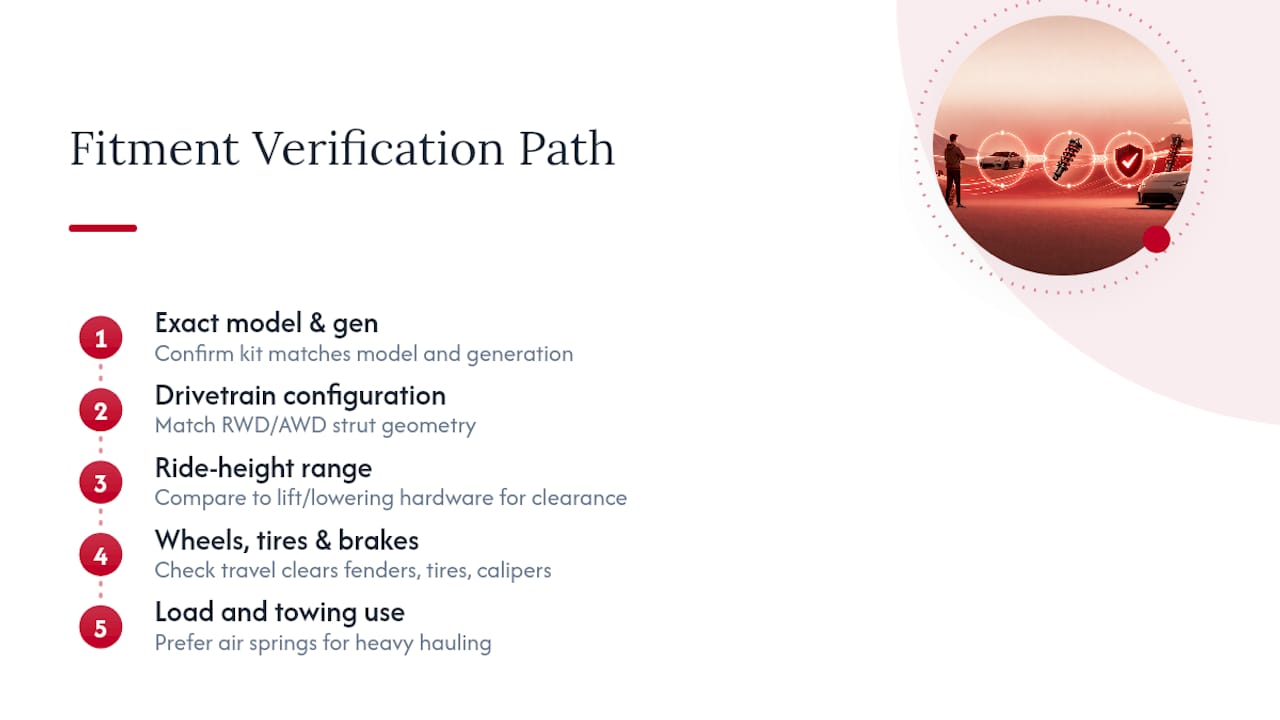
Aftermarket wheels and tires change the compatibility picture too. Wider wheels or lower-profile tires shift how much suspension travel you actually have before something contacts the fender or the tire itself. If you’re running larger brakes, confirm the coilover’s lower mount and knuckle interface still clear the caliper. And if the vehicle tows or hauls regularly, a street-tuned coilover kit may not be the right call at all. A better fit might be an air spring solution designed for load-carrying rather than a fixed-rate performance spring.
None of this is guesswork if you buy from a source that verifies fitment against your specific vehicle before shipping, rather than relying on a generic “fits most” listing.
The Real Question Isn’t Which Brand, It’s Which Setup
The conventional advice on coilovers spends too much time ranking brands and not enough time asking whether the buyer actually knows what they need. That’s backwards. A mid-tier kit with the right spring rate and a rider willing to spend a weekend tuning it will outperform a premium kit thrown on and left at factory settings.
What gets overrated constantly: adjustability range as a headline spec. Thirty-two clicks of damping adjustment sounds impressive, but it’s meaningless if nobody ever tells you where to start or how to test changes methodically. What gets underrated: fitment verification and manufacturer support, which is exactly what determines whether your coilover experience is smooth or a two-month ordeal of return shipping and refunds.
If there’s one thing to prioritize first, it’s this: know your driving goal before you shop, not after. Street-oriented setups with the right spring and damping choices can genuinely improve daily comfort over tired factory shocks. Track-first kits almost never do. Buy for the car you actually drive, not the one you imagine racing on weekends you don’t have.
— Ozkonic Kustomz
Get the Right Kit the First Time With Ozkonic Kustomz
Some suppliers source coilovers, suspension components, and adjacent hardware directly from vetted manufacturers, verifying fitment against your specific vehicle before shipping. This approach reduces the risk of purchasing universal fit kits that do not clear your knuckle or counterfeit parts sold as OEM-spec.
Beyond coilovers, the catalog covers the parts that round out a suspension upgrade properly, including hardware and latch components for builds that need reliable, verified-fit accessories, like the modular wiring kit built for truck installs or the latch kit designed for secure exterior fitment. Fast shipping and a straightforward return policy can help minimize delays if a part does not fit despite the verification process. Browse the suspension category, check the listed fitment for your exact model, and reach out to support if you’re unsure which spring rate or damping setup matches your build before you check out.
Sources
- A Year With High-Performance Suspension on My Daily Driver: What I Learned
- Coilover Setup Guide for Street & Track | Atomic Autosports
- What Are Coilovers And Should You Get Them? An Explainer
FAQ
What Are the Best Coilovers for Daily Driving?
Look for street-oriented kits with progressive or moderately linear springs, adjustable rebound damping, and a ride-height range that keeps you close to stock geometry. Kits tuned this way are often more comfortable than worn factory shocks while still sharpening handling.
Which Coilovers Have the Smoothest Ride?
Kits with progressive spring rates and independently adjustable compression and rebound damping generally ride smoothest, since you can soften the setup for daily roads without sacrificing the ability to stiffen it later. Rebuildable dampers also tend to maintain a smoother feel longer than sealed, non-serviceable units.
Are BC or Bilstein-Style Coilovers Better?
Neither category wins outright. Kits with wide adjustability ranges and stiffer default tunes suit drivers who plan to tinker, while kits with smoother factory-like damping curves out of the box suit drivers who want a set-and-forget street setup.
Are Coilovers Good for Daily Driving?
Yes, when spring rates and damping are chosen for street use rather than track duty. Quality street-tuned coilovers can match or beat tired factory suspension for comfort while improving cornering response.
How Do I Verify a Coilover Kit Fits My Vehicle?
Confirm the kit is listed for your exact model, generation, and drivetrain, not a generic “universal fit” claim, and buy from a supplier like Ozkonic Kustomz that checks fitment against your vehicle before shipping.