
LED truck lighting covers a lot of ground: headlight assemblies, light bars, driving pods, bed strips, rock lights, underglow, trailer markers, and signal LEDs. Before you buy anything, confirm your vehicle year/make/model, check whether the product carries a DOT/SAE marking or an “off-road use only” label, and verify CAN-bus compatibility with your truck’s electrical system. Measure every mounting location first. A bar that’s two inches too wide for your roof rack or bumper creates fitment and legal problems that no amount of zip ties will fix.
Quick pre-purchase checklist:
- Note your vehicle year, make, model, and trim
- Identify housing or plug type for any bulb swap
- Measure mounting width, depth, and height above ground
- Confirm DOT/SAE marking for on-road use, or plan to cover/switch off for highway transit
- Check whether your truck uses a CAN-bus system (most post-2010 models do)
Table of Contents
- What types of LED truck lights do you actually need?
- Why truck owners switch to LED lighting
- How do you pick the right LED lights for your truck?
- What do you need to know about wiring and installation?
- Where should you mount LED lights on your truck?
- What causes LED lights to fail after installation?
- How much does LED truck lighting cost, and how long does it take?
- What are the U.S. road-legal rules for LED truck lighting?
- Key Takeaways
- The part of LED upgrades most buyers get wrong
- Ozkonickustomz has the parts and fitment support you need
- Useful sources
What types of LED truck lights do you actually need?
The category you choose should match the job, not just the look. Here’s how the main types break down:
- Headlight assemblies and LED bulb swaps — direct replacements for factory halogen or HID housings; the most common first upgrade for highway visibility
- LED light bars (spot, flood, combo) — long-range off-road illumination or worksite coverage; spot beam angles typically run 8–15°, flood 30–60°, combo blends both
- Driving and fog lamps — bumper- or grille-mounted, often DOT/SAE-rated for legal on-road use; the practical alternative to a roof bar for daily drivers
- Underbody and underglow strips — styling and low-level illumination; state rules on color vary significantly
- Bed and tailgate lighting — cargo and worksite lighting aimed rearward or downward; sealed connectors are non-negotiable here
- Grille, marker, and rock lights — accent and off-road trail lighting; low-profile housings protect against debris
- Pod and work lamps — compact, flexible mounting for targeted illumination at worksites or on trails
- Trailer and side-marker LEDs — LED trailer lighting replacements must meet 49 CFR 393.11 color and position requirements for commercial and tow vehicles
Bumper-mounted driving lights are legal on public roads when DOT-marked and mounted within prescribed height limits, yet bright enough for trail approaches. Roof bars deliver the most raw range but are almost always restricted to off-road use on public highways.
Why truck owners switch to LED lighting
The core argument for LED is efficiency and durability, not just brightness. LEDs produce significantly more usable light per watt than halogen bulbs, and quality units are rated for tens of thousands of hours of operation. That lifespan advantage matters on a work truck that runs lights daily.
Power draw is lower too. A halogen fog lamp with high wattage can often be replaced with an LED drawing significantly less power for comparable or better output. That gap adds up on a truck running multiple auxiliary lights simultaneously.
Vibration resistance is another real-world advantage. LEDs have no filament to break, which matters on rough trails or unpaved job sites. Pair that with a properly sealed housing (IP67 or better) and you have a light that survives conditions that kill halogen bulbs in weeks.
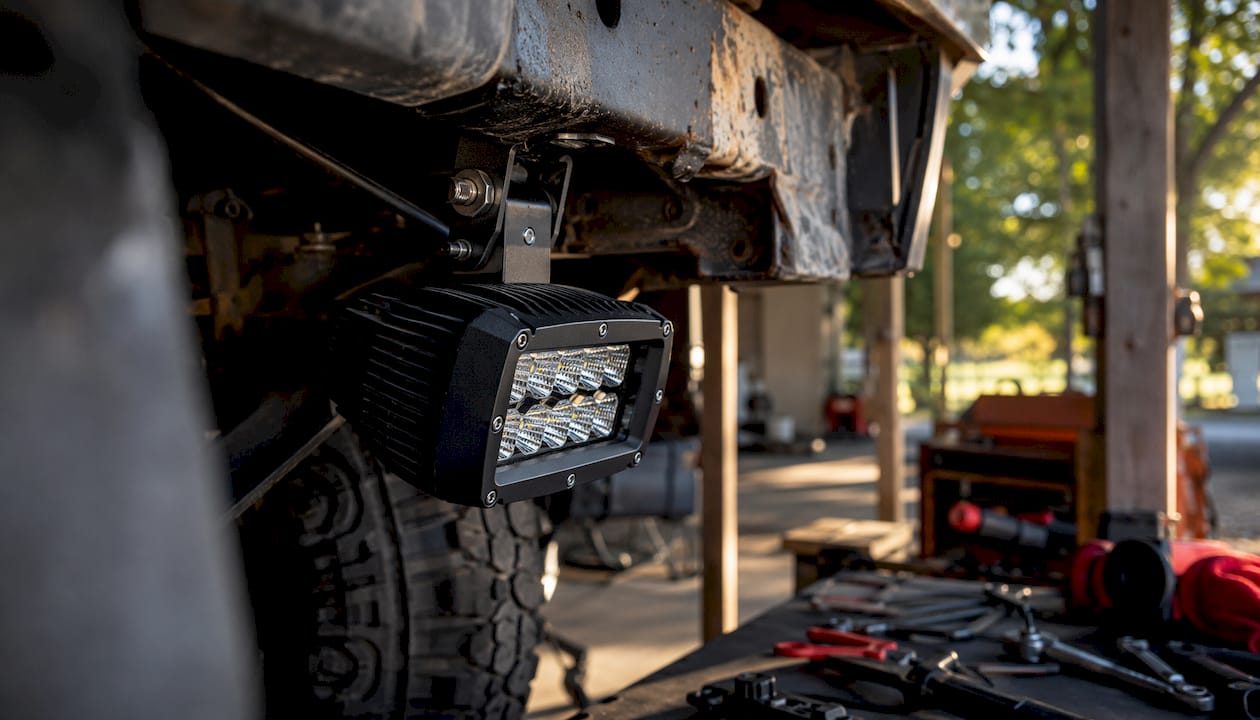
Thermal management is the variable most buyers overlook. Every 10°C rise above optimal operating temperature roughly halves LED lifespan. Quality units use die-cast aluminum housings with thermal pads or increased fin area. A simple field test: run the light at full power for 30 minutes and feel the housing. Warm is fine. Too hot to hold means the thermal path is inadequate.
How do you pick the right LED lights for your truck?
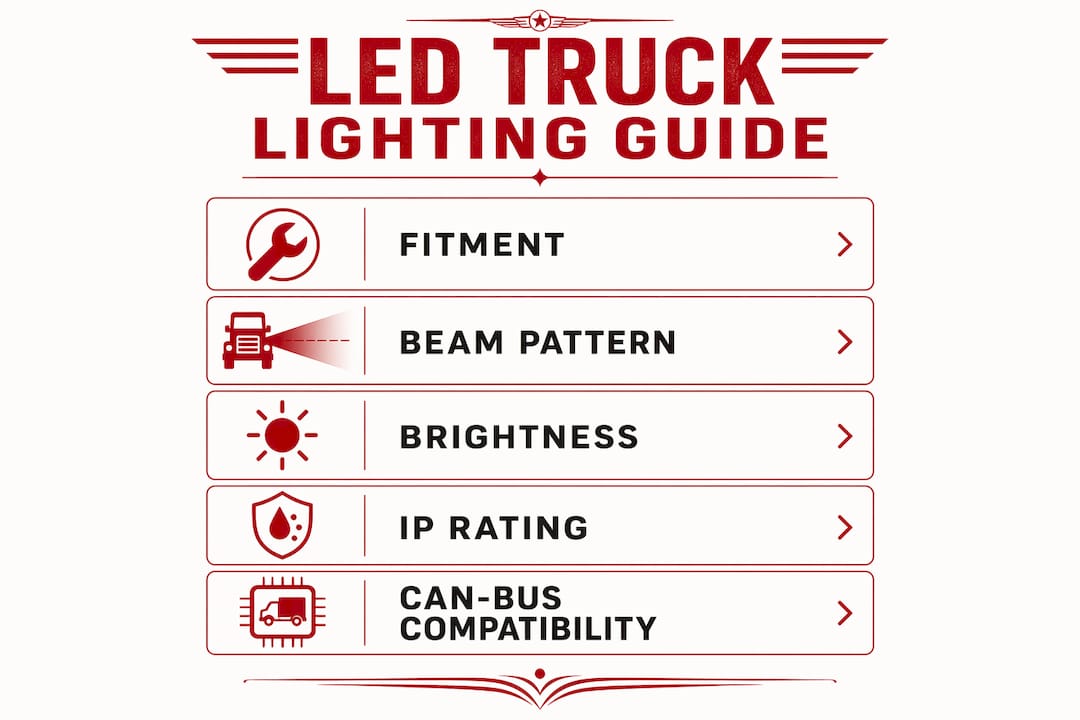
Start with fitment, not lumens. A light with the wrong mounting pattern or connector type is useless regardless of its output spec.
Fitment and compatibility first
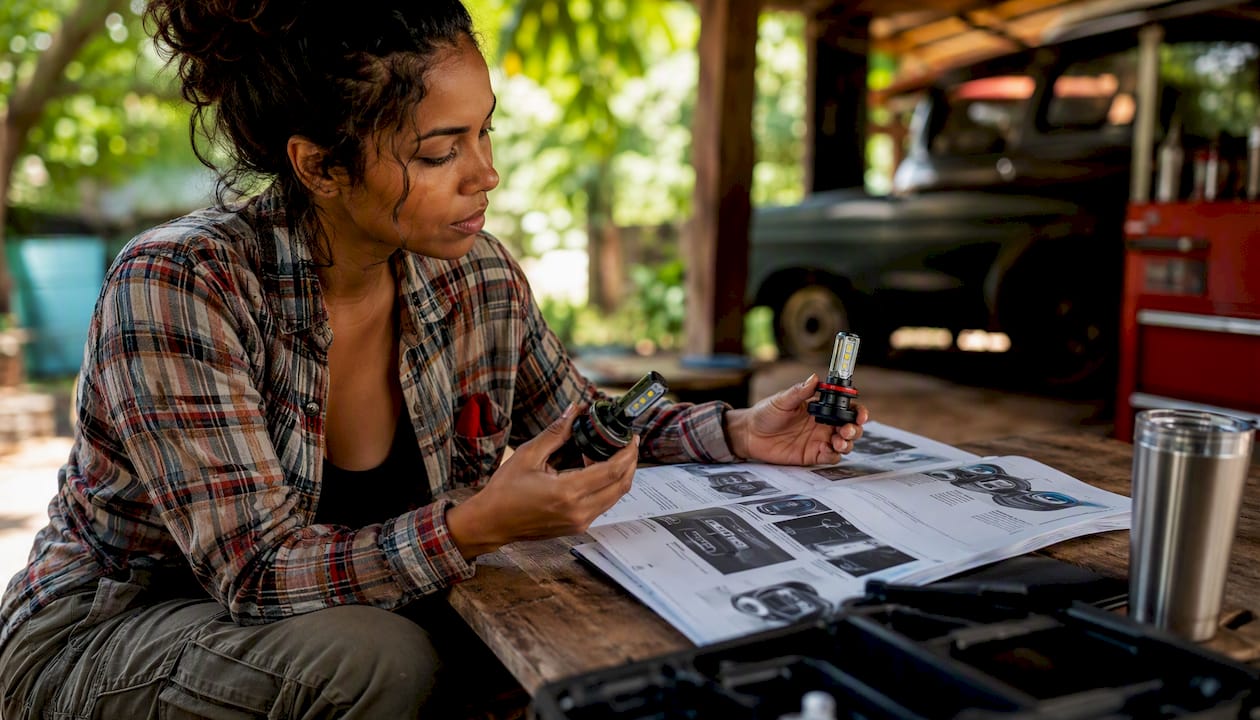
Match the light to your vehicle’s year, make, and model. For bulb swaps, identify the OEM bulb code (H11, 9005, H4, etc.) and confirm the replacement fits the housing without modification. For light bars and pods, measure before buying — bar length should match your roof rack, bumper, or chase rack width.
Beam pattern for the job
Spot beams (8–15°) throw light far down the road, ideal for high-speed off-road or rural highway driving. Flood beams (30–60°) spread light wide and low, better for worksites and slow trail work. Combo beams blend both and suit most daily-driver builds that occasionally go off-road.
Brightness metrics to trust
Raw lumen claims are often inflated. Focus on lumens-per-watt (100–200 lm/W is a realistic range for quality LEDs) and published lux-at-distance charts. A light with a well-designed optical system will outperform a higher-lumen unit with poor beam shaping at any real-world distance.
Color temperature and consistency
Most truck owners land between 5,000K and 6,000K for white forward lighting. Mixing brands with different Kelvin values creates uneven illumination that’s visually fatiguing on long drives. If you’re building out multiple positions, source matched light families or full kits with verified beam charts.
IP rating for your conditions
IP67 handles rain and brief submersion. IP68 covers extended submersion. IP69K adds high-pressure wash resistance, relevant for bed lights on work trucks that get pressure-washed regularly. Underglow and rock lights need at least IP67 given road spray and debris.
CAN-bus compatibility
Most trucks built after 2010 use CAN-bus systems that can misinterpret the low current draw of LEDs as a burned-out bulb, triggering flicker, hyper-flash, or error codes. Premium LED units include built-in decoders; budget units often require external load resistors.
Pro Tip: Before ordering, search your truck’s year/make/model alongside “CAN-bus LED error” to see whether other owners have encountered compatibility issues with the specific bulb position you’re upgrading.
| Installation type | Recommended category | Key spec to verify |
|---|---|---|
| Headlight bulb swap | CAN-bus compatible LED bulb | OEM bulb code, housing clearance |
| Bumper driving lights | DOT/SAE-marked fog or driving lamp | Mounting height 16–42 in, SAE marking |
| Roof light bar | Combo or spot bar | Bar width vs. rack width, cover for on-road |
| Bed/cargo lighting | IP67+ LED strip or work lamp | Sealed connectors, conduit protection |
| Rock lights | IP67+ low-profile pod | Separate switch circuit, debris clearance |
| Trailer markers | DOT-compliant LED marker | 49 CFR 393.11 color/position compliance |
What do you need to know about wiring and installation?
Wiring done wrong is the most common reason LED upgrades fail within a year. The light itself is usually fine; the circuit feeding it isn’t.
Core wiring rules:
- Run a dedicated circuit for any auxiliary light — never tap into an existing circuit already near capacity
- Size the fuse to the light’s actual draw, not the wire gauge
- Use a relay for any light drawing more than 5A to keep high current off the switch
- Use marine-grade or sealed connectors for bed, underglow, and underbody runs
- Apply dielectric grease to every connector before seating
Step-by-step for a basic auxiliary light install:
- Calculate the light’s amp draw (watts ÷ 12V = amps)
- Select wire gauge for that draw plus a 20% safety margin
- Run a fused positive lead from the battery through a relay
- Ground the relay and the light to a clean chassis point, not a body panel
- Run a low-current trigger wire from your switch to the relay coil
- Test continuity and voltage drop under load before final mounting
For CAN-bus systems, install a load resistor or decoder inline with the affected circuit. If you’re integrating traffic advisors, strobe controllers, or fleet telematics, hire a professional — the interaction between those systems and a truck’s body control module can create faults that are expensive to diagnose.
Pro Tip: After install, check voltage at the light connector with the engine running. A reading below 13.5V under load suggests a wiring or ground issue that will shorten LED life.
Where should you mount LED lights on your truck?
Location determines both performance and legal exposure. Get this wrong and you’re either leaving output on the table or collecting citations.
- Bumper and grille driving lamps: Keep mounting height within a range that satisfies most state auxiliary light rules and ensures the beam pattern is aimed correctly for on-road use.
- Roof-mounted bars: Maximum range, but many states require opaque covers on public roads even when the lights are switched off. Wire them on an independent circuit with a clearly labeled switch.
- Bed and tailgate lights: Aim downward for cargo illumination. Use sealed connectors and run wiring through conduit to protect against abrasion from cargo and tailgate operation.
- Underglow and rock lights: Mount as high off the ground as the application allows to reduce debris impact. Wire on a separate switch so they can be killed independently. Low-profile housings survive trail use better than protruding units.
- Rear-facing lights: Most states prohibit rear-facing high-intensity whites unless wired to operate only in reverse. Wire any rear work bar through the reverse circuit or a separate switch that cannot activate in forward gear.
- Signal colors: Keep turn signals and hazard markers amber, stop lamps red. Never run red or blue forward-facing LEDs — that’s reserved for emergency vehicles in every state.
What causes LED lights to fail after installation?
Most post-install problems trace back to one of four causes, and all of them are fixable.
- Flicker or hyper-flash: Test whether the truck’s CAN-bus is detecting the LED as a fault. Add a load resistor or CAN-bus decoder inline. For turn signals specifically, an LED-compatible flasher relay (like the Painless Wiring LED flasher unit) resolves hyper-flash without resistors.
- Condensation or water ingress: Inspect the housing seal. If the IP rating is IP65 or lower and the light is in a high-spray location, replace with an IP67+ unit. Reseal any penetrations with silicone rated for automotive use.
- Reduced output over time: Check the thermal path. If the heatsink is blocked by a mounting bracket or the housing is enclosed without ventilation, the LED junction temperature climbs and output drops. Also verify voltage at the connector under load.
- Loose connectors and corroded grounds: Clean with electrical contact cleaner, apply dielectric grease, and reseat. A corroded ground is the single most common cause of intermittent failures and phantom error codes.
Quick diagnostic checklist:
- Measure voltage at the light under load (engine running, light on)
- Inspect ground connection at the chassis point
- Check for moisture inside the housing
- Feel housing temperature after 30 minutes at full power
- Confirm CAN-bus decoder is seated and wired correctly
How much does LED truck lighting cost, and how long does it take?
| Category | Typical retail price range | DIY install time | Pro install time |
|---|---|---|---|
| LED bulb swap per pair | typically inexpensive, with installation taking under an hour | ||
| Pod lights / driving lamps | usually costing a moderate amount per pair, with installation taking between one and a few hours | ||
| Mid-range light bar of moderate length | $80–$100 | 2–4 hours | 2–3 hours |
| High-end light bar or integrated assembly, typically requiring several hours for installation | |||
| Bed / tailgate strip kit | $40–$200 | 1–2 hours | 1 hour |
| Rock lights (set of 4–6) | $60–$100 | 2–4 hours | 2–3 hours |
Extra costs to budget: wiring harness ($20–$80), relay and fuse kit ($10–$30), CAN-bus decoders or load resistors ($15–$60), mounting brackets ($20–$100), and opaque covers for roof bars ($20–$50). Cheap upfront pricing often means no thermal management, no IP rating, and no warranty — replacement costs can exceed the original purchase within a season.
What are the U.S. road-legal rules for LED truck lighting?
Most aftermarket LED light bars carry an “off-road use only” label because they were never tested to meet FMVSS 108, the federal standard governing highway lighting. Using them on public roads can result in equipment citations and creates insurance liability exposure if they contribute to an accident.
FMVSS 108 sets the baseline. SAE markings tell you what a light was designed to do: SAE F for fog lamps, SAE Y for driving lamps, SAE Z for auxiliary lamps. A product with one of these markings was tested to that function’s photometric standard. No marking means no test.
State rules layer on top of the federal baseline. Most states limit forward-facing auxiliary lights to white or amber, set mounting height ranges commonly between 16 and 42 inches, and restrict or ban roof-mounted bars on public roads. New York effectively bans all commercial light bars by capping auxiliary light output at 32 candlepower. Arkansas prohibits most aftermarket auxiliary lights on public roads entirely. Texas allows two auxiliary lamps mounted between 16 and 42 inches. California requires off-road lights to be switched off and covered with an opaque cover on any public road.
The practical rule: if you drive on public roads, buy DOT/SAE-marked products for any light that stays uncovered. Use opaque covers for roof bars and wire auxiliary lights to an independent, clearly labeled switch. Red and blue forward-facing LEDs are reserved for emergency vehicles in every state — running them risks criminal charges, not just an equipment ticket.
Pro Tip: Before purchasing any auxiliary light, look up your state’s vehicle code section on auxiliary lamps and check your state DMV’s equipment rules. State laws change, and what was legal last year may not be this year. For multi-state travel, follow the most restrictive state on your route.
This article is general information, not legal advice. Confirm current rules with your state DMV or a qualified professional for your specific situation.
Key Takeaways
LED truck lighting upgrades deliver real gains in output, efficiency, and durability — but fitment, legal compliance, and proper wiring determine whether those gains actually hold up on the road.
| Point | Details |
|---|---|
| Confirm fitment first | Match year/make/model, plug type, and mounting dimensions before ordering any light. |
| Verify DOT/SAE markings | Only SAE/DOT-marked lights belong on public roads uncovered; “off-road use only” creates citation and insurance risk. |
| Check CAN-bus compatibility | Post-2010 trucks often need built-in decoders or external load resistors to prevent flicker and error codes. |
| Use a dedicated circuit | Run a separate fused relay circuit for every auxiliary light; never tap an existing circuit near capacity. |
| Shop Ozkonickustomz for vetted parts | Ozkonickustomz carries fitment-guaranteed LED components, wiring harnesses, and signal hardware with compatibility support. |
The part of LED upgrades most buyers get wrong
The most common mistake isn’t buying the wrong beam pattern or skipping the IP rating check. It’s buying on price alone and ignoring the thermal and electrical side of the install. A $40 light bar with no heatsink and a flimsy connector will fail in six months on a work truck. The $150 unit with a die-cast housing and a sealed wiring harness will still be running in three years.
The second mistake is treating “off-road use only” as a suggestion. That label is a legal signal. It means the product was never tested to FMVSS 108, and if it contributes to an accident on a public road, your insurance carrier has grounds to dispute the claim. The cover and the switch aren’t inconveniences — they’re the difference between a trail accessory and a liability.
Mixing light families is the third trap. Two bars from different brands at different Kelvin values look fine in the parking lot and terrible on a dark highway. Source matched kits or verify beam charts before combining products. Ozkonickustomz carries curated lighting components with fitment guarantees and compatibility support, which is exactly the kind of sourcing discipline that prevents mismatched builds.
Ozkonickustomz has the parts and fitment support you need
Hard-to-find LED truck lighting components, wiring harnesses, switches, and signal hardware — Ozkonickustomz sources directly from vetted manufacturers so every part ships with confirmed fitment and real compatibility support.
The catalog includes headlight assemblies for classic trucks, Rally Sport headlight wiring for vintage builds, rear body light harnesses for clean trailer and bed wiring, and LED-compatible turn signal flashers that eliminate hyper-flash without resistors. Every listing includes fitment data so you know what you’re getting before it ships.
Gather your vehicle year, make, model, and trim, then shop the full parts catalog or contact fitment support directly. Fast shipping, straightforward returns, and no guesswork on compatibility.
Useful sources
- FMVSS 108 — Lamps, Reflective Devices, and Associated Equipment (49 CFR § 571.108) — federal standard governing all highway lighting requirements; backs all FMVSS 108 legal claims
- 49 CFR § 393.11 — Lamps and Reflective Devices (Cornell LII) — commercial vehicle lighting position and color requirements; backs trailer and marker LED compliance claims
- Off-Road LED Use Only Disclaimers and OHV Lighting Rules (LegalClarity) — explains “off-road use only” labeling and FMVSS 108 non-compliance implications
- Can You Drive With a Light Bar On? Laws Explained (LegalClarity) — covers cover requirements, rear-facing light restrictions, and on-road auxiliary light rules
- Light Bar Laws by State: Off-Road LED Rules (4WD Talk) — state-by-state summary of mounting height, color, and cover requirements
- Off-Road Light Bar Laws That Get Truck Owners Ticketed in 14 States (Vehicle HQ) — detailed state-level rules and fine ranges for auxiliary light violations
- Truck LED Lights Buyer’s Guide — What the Spec Sheets Don’t Tell You (GTR Lighting) — technical sourcing for beam pattern angles, lumen/lux guidance, CAN-bus issues, and thermal management
- How to Choose Light Bars for Trucks: The Complete Buyer’s Guide (Strobes N’ More) — fitment and sizing guidance for light bar selection
- The Motor Carrier Safety Planner — Lighting Devices and Reflectors (FMCSA) — FMCSA guidance on commercial vehicle lighting device and reflector requirements