
Lowering a truck pulls the chassis closer to the road by changing suspension geometry, spring height, or both — and the honest bottom line is this: you gain a sharper stance, reduced body roll, and noticeably better cornering feel, but you trade away ground clearance and some daily usability if the build isn’t planned carefully. Lowering reduces the vehicle’s center of gravity, which tightens steering response and cuts body roll during cornering and braking compared to factory ride height. Done right, a lowered truck feels planted and purposeful. Done wrong, it scrapes driveways and chews through tires.
A few things to know before you go further:
- Drop notation uses two numbers: front drop / rear drop. A 2/4 kit means 2 inches front, 4 inches rear.
- Every kit is sold by year, make, model, and drivetrain — fitment is not universal.
- DOT and state-level minimum ground clearance laws apply; confirm your target drop is street-legal in your state before buying.
- Ozkonickustomz carries vetted aftermarket truck suspension components with guaranteed fitment and direct sourcing from manufacturers.
A well-planned moderate drop — mild front, slightly deeper rear — typically delivers the stance and handling most truck owners want without gutting daily usability.
Table of Contents
- What are the main types of lowered truck suspension kits?
- What are the real benefits and drawbacks of lowering a truck?
- How much does it cost to lower a truck?
- How do you choose the right lowering approach for your truck?
- What does a proper installation actually involve?
- How do you maintain a lowered suspension long-term?
- Are lowered trucks legal, and will they pass inspection?
- How does lowering affect your warranty and insurance?
- Pros and cons by suspension type: a direct comparison
- Ozkonickustomz has the parts and fitment support you need
- Key Takeaways
- The stance obsession is real, but the system thinking is what actually matters
What are the main types of lowered truck suspension kits?
Not all lowering methods work the same way, and the right choice depends entirely on how you use the truck.
Lowering springs
Stiffer, shorter replacement springs that drop the front and rear by roughly 1–3 inches. They’re the most affordable entry point, bolt into the stock location, and usually preserve a reasonable ride when paired with matched shocks. For a mild street stance on a daily driver, they’re hard to beat on value. For a deeper comparison of springs versus adjustable options, the coilovers vs. lowering springs breakdown at Ozkonickustomz is worth reading before you buy.
Drop spindles
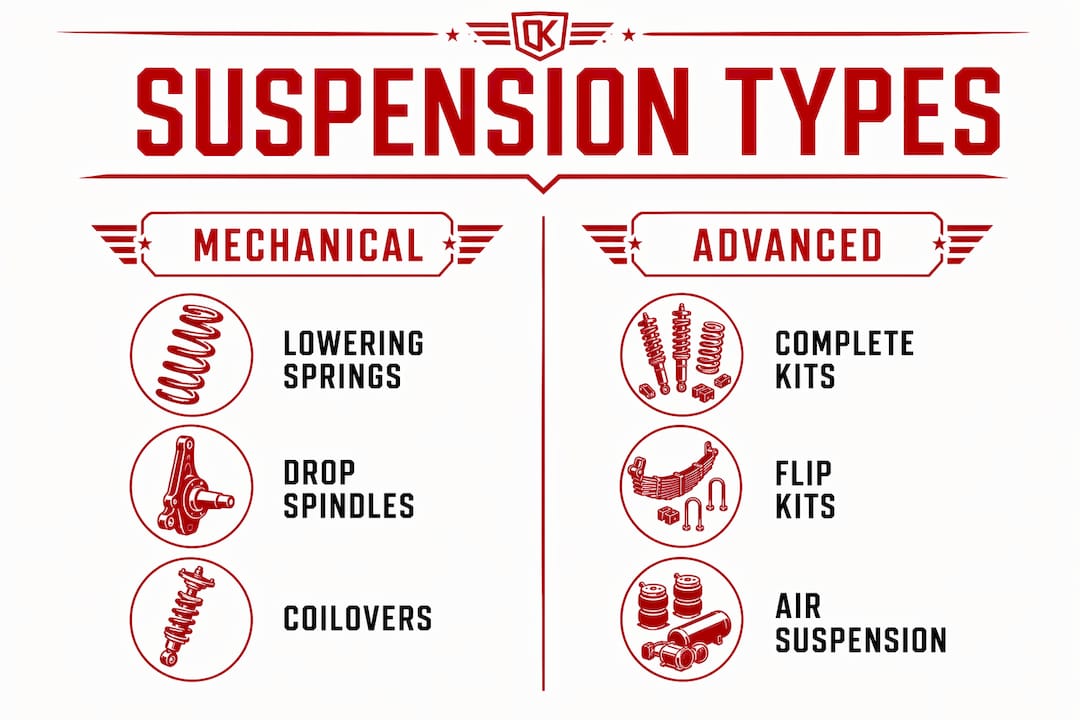
Drop spindles deliver 2–3 inches of front drop while keeping the factory spring rate almost entirely intact. Because the spindle repositions the wheel hub lower rather than compressing the spring, ride quality suffers less than with many other front-end methods. They’re a smart pick for trucks where ride comfort matters as much as stance.
Coilovers
A coilover combines the spring and shock into one adjustable unit. Height is tunable, damping is often adjustable, and the handling improvement over stock is significant. The trade-off is cost: a quality coilover set runs considerably more than a basic spring kit, and installation takes longer.
Complete lowering kits (front + rear combos)
These bundle everything needed for both ends of the truck — struts or spindles up front, flip kits or hangers and shackles out back — and are sold as matched systems. A 2/4 or 3/5 kit from a reputable manufacturer includes components sized to work together, which removes much of the guesswork around shock compatibility.
Flip kits, hangers, and shackles (leaf-spring rears)
On trucks with leaf-spring rear suspensions, flipping the axle from above the spring to below it is the most common way to get 3–5 inches of rear drop. Hangers and shackles extend the range. Drops of 4–6 inches often require a C-notch in the frame to prevent the axle from contacting the frame at full compression.
Air suspension
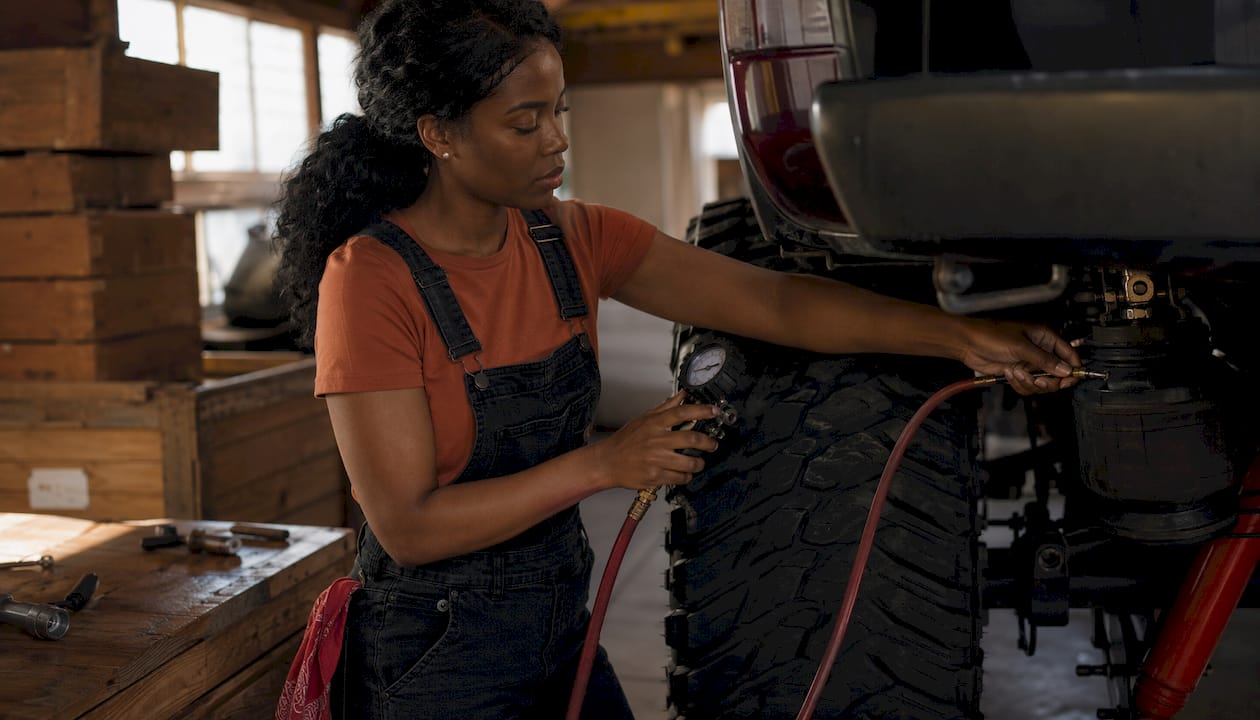
Air suspension offers the widest adjustability — you can park slammed and raise the truck for clearance on the road. The cost and system complexity are real, though. Air is the right call for show trucks or anyone who genuinely needs daily height adjustability; it’s overkill for a truck that just needs a cleaner stance. Ozkonickustomz stocks air spring kits for common truck applications.
| Method | Typical Drop (F/R) | Best Use Case | Complexity |
|---|---|---|---|
| Lowering springs | 1–3" / 1–3" | Daily driver, mild stance | Low |
| Drop spindles | 2–3" front only | Comfort-focused street build | Low–Medium |
| Coilovers | 1–4" / varies | Performance handling, tunable | Medium–High |
| Complete kit | 2/4, 3/5, 4/6 | Balanced stance, matched system | Medium |
| Flip kit + hangers | 3–6" rear | Aggressive rear drop, leaf-spring trucks | Medium–High |
| Air suspension | adjustable | Show builds, daily adjustability | High |
What are the real benefits and drawbacks of lowering a truck?
Benefits
- Lower center of gravity reduces body roll and improves cornering stability.
- Sharper steering feel — the truck responds more directly to inputs.
- Visual proportions tighten up; the wheel-gap shrinks and the truck looks purposeful rather than tall and ungainly.
- Potential aerodynamic gains at highway speeds from reduced frontal area and undercarriage exposure.
Drawbacks
- Reduced ground clearance is the biggest daily trade-off — speed bumps, steep driveways, and unpaved roads become genuine obstacles.
- Ride harshness when stock shocks are left in place after lowering; mismatched parts are the primary cause of comfort loss.
- Uneven or accelerated tire wear if alignment isn’t corrected after the drop.
- Rubbing risk at full lock or over bumps if wheel/tire offset isn’t planned alongside the kit.
- Towing and load capacity can be affected, particularly with aggressive rear drops that change pinion angle.
Pro Tip: Always replace or re-valve shocks to match the new ride height, and budget for a four-wheel alignment immediately after installation. Skipping either step is the fastest way to ruin an otherwise solid build.
Approach-angle testing matters too. Before committing to a drop depth, drive the route you use every day and note the steepest driveway or parking structure ramp. A 4-inch rear drop that looks great in a parking lot can become a daily frustration at a steep gas station entrance.
How much does it cost to lower a truck?
Parts and labor together typically range from about $1,500 to $4,000 or more, depending on kit type, vehicle, and shop rates.
| Tier | Kit Cost | Labor | Alignment | Typical Total |
|---|---|---|---|---|
| Entry (springs, basic) | $300–$600 | $1,000–$2,000 | several hundred dollars | $1,500–$2,000+ |
| Mid-range (coilovers, matched shocks) | $600–$1,000 | $1,000–$2,000 | several hundred dollars | $2,000–$3,000+ |
| Full system (premium coilovers, air, or deep drop) | $1,000–$1,500+ | $1,000–$2,000+ | several hundred dollars | $3,000–$4,000+ |
Sources: Cost Insider, DJM Suspension
Hidden costs that catch people off guard:
- Shocks/struts ($200–$900) if not included in the kit — and they often aren’t in entry-level packages.
- C-notch or frame work for drops beyond 4 inches; this is shop-only territory and adds meaningful labor hours.
- Wheel and tire changes — offset, width, and sidewall height often need to change to prevent rubbing.
- Bump-stop trimming or replacement to maintain proper suspension travel.
Labor alone runs 6–14 hours depending on kit complexity. A shop that charges a flat rate for the complete job, alignment included, is usually the better deal than hourly billing on a complex build. DIY is viable for bolt-on spring swaps, but anything involving frame work or air system plumbing needs a lift, specialty tools, and alignment equipment most home garages don’t have.
How do you choose the right lowering approach for your truck?
Work through these steps before you spend anything.
-
Define how you actually use the truck. Daily driver with occasional towing? A 2/2 or 2/4 static kit is the sensible ceiling. Show truck that rarely leaves smooth pavement? You have room for a deeper drop or air. Off-road use even occasionally? Lowering is probably the wrong direction entirely.
-
Pick a realistic drop target. A 2/4 setup is the sweet spot for most street-driven trucks — enough visual change to matter, not so much that you’re C-notching the frame or fighting every driveway. Drops beyond 4 inches in the rear almost always require frame modifications.
-
Match the method to the use case. Springs and drop spindles for mild daily builds. Complete kits for balanced front-and-rear stance. Coilovers when handling performance is the priority. Air when you need to adjust height on the fly.
-
Plan wheels and tires at the same time. Buying the kit first and figuring out wheels later leads to rubbing, iterative costs, and frustration. Decide offset and tire sidewall before you order anything.
-
Ask the right questions before buying. From any parts seller or shop: Does this kit fit my exact year/make/model/drivetrain? Are shocks included or sold separately? What alignment specs does the install require? Is there a return policy if fitment is wrong? Do I need a C-notch or pinion-angle correction for this drop?
Red flags to avoid: any vendor who suggests cutting factory springs to lower the truck (a dangerous shortcut that destroys spring rate predictability), kits sold without fitment-specific information, and shops that quote installation without mentioning alignment.
What does a proper installation actually involve?
A competent shop will check every one of these before calling the job done:
- Shock length and valving matched to the new ride height
- Bump-stop clearance at full compression
- Brake hose routing (lowering changes the geometry; hoses can bind or stretch)
- Control arm and ball-joint angles, especially on IFS trucks
- Full four-wheel alignment to spec
- Wheel and tire clearance at full lock and full compression
Skipping post-lowering alignment is the single most common build failure. It leads directly to rapid, uneven tire wear and handling that feels vague or unpredictable. Replacing shocks to match reduced travel isn’t optional — it’s what separates a truck that rides well from one that crashes over every expansion joint.
Lowering is a multi-system upgrade. Bump-stop clearance, wheel offset, drivetrain and exhaust routing, and shock travel must all be planned together — not addressed one at a time after problems appear.
Ozkonickustomz sources components directly from vetted manufacturers and provides fitment lookup by year/make/model so you’re not guessing about compatibility. For a model-specific example of how fitment checks and parts lists come together, the Ram 1500 lowering kit deep dive on the Ozkonickustomz blog walks through the process in detail.
Pro Tip: After the first week of driving on a new lowered setup, re-check clearances and re-torque U-bolts and suspension fasteners. Components settle under load, and a quick re-torque prevents loosening that develops into noise or handling drift.
How do you maintain a lowered suspension long-term?
A lowered truck puts more stress on certain components than a stock-height vehicle does, and the maintenance schedule needs to reflect that.
Inspect ball joints and tie rod ends more frequently than the factory interval suggests. Reduced suspension travel means these components cycle through a narrower range more often, and wear can accelerate. Wheel bearings deserve the same attention, particularly on trucks with aggressive negative camber from the lowered geometry.
Alignment drift is a real issue. Even a well-aligned lowered truck will drift out of spec faster than a stock one if you hit a significant pothole or curb. Check alignment every 12,000–15,000 miles rather than waiting for tire wear to tell you something is wrong.
Shock absorbers on a lowered truck work in a compressed range of their travel. Quality shocks designed for the lowered height will outlast repurposed stock units, but they still wear. If the ride starts feeling crashy or the truck rebounds slowly after a bump, the shocks are the first thing to inspect.
For trucks with air suspension, the compressor, air lines, and bags need periodic inspection for leaks and wear. Air fittings and line connections are the most common failure points; catching a slow leak early prevents a compressor burnout.
Are lowered trucks legal, and will they pass inspection?
U.S. vehicle modification laws are set at the state level, not federally, which means the rules vary significantly depending on where you register and drive the truck.
Most states that regulate vehicle height focus on minimum ground clearance (commonly 4–6 inches measured at the frame or lowest structural point) and headlight height (typically a minimum of 24 inches from the ground). Some states also regulate how far the body can be lowered relative to the axle. California, for example, has specific rules about body-to-frame height and bumper height that can affect lowered builds.
Before committing to a drop depth, check your state’s DMV or vehicle code for the specific numbers. A 4-inch rear drop that’s legal in Texas may fail a safety inspection in another state. If you’re in a state with annual safety inspections, ask the inspection station what they measure and what the pass/fail threshold is — before the build, not after.
Federal safety standards (FMVSS) govern lighting, braking, and structural integrity but don’t set a universal minimum ride height for passenger trucks. The practical floor is whatever your state requires.
This article is general information, not legal advice. Confirm current regulations with your state’s DMV or a qualified automotive professional for your specific vehicle and situation.
How does lowering affect your warranty and insurance?
Warranty: The Magnuson-Moss Warranty Act protects consumers from blanket warranty voids due to aftermarket parts. A dealer cannot void your entire powertrain warranty simply because you installed a lowering kit. However, if a suspension modification causes a specific component failure — say, a CV axle fails because of an extreme angle created by an aggressive drop — the dealer can deny that specific claim. Document your build, use quality parts with fitment guarantees, and keep receipts.
Insurance: Most standard auto insurance policies cover modified vehicles, but the insurer needs to know about significant modifications. Failing to disclose a lowered suspension and then filing a claim related to suspension damage can result in a denied claim. Some insurers offer agreed-value or stated-value policies that explicitly cover modified vehicles; these are worth exploring if your build represents significant investment. Call your insurer before the install, not after.
Pros and cons by suspension type: a direct comparison
| Type | Main Pros | Main Cons | Best For |
|---|---|---|---|
| Lowering springs | Affordable, bolt-in, mild ride impact | Limited drop range, needs matched shocks | Daily drivers, budget builds |
| Drop spindles | Preserves ride quality, 2–3" front drop | Front-only solution, limited drop | Comfort-focused street trucks |
| Coilovers | Adjustable height and damping, performance gains | Higher cost, longer install | Performance builds, tunable stance |
| Complete kits | Matched system, balanced F/R drop | Less tunable than coilovers | Most street builds |
| Flip kit + hangers | Deep rear drop, cost-effective for leaf springs | Frame work needed at 4"+, affects towing | Aggressive static stance |
| Air suspension | Fully adjustable, show-to-drive versatility | Highest cost and complexity, maintenance | Show trucks, daily adjustability |
Ozkonickustomz has the parts and fitment support you need
Getting the stance right starts with parts that actually fit your truck. Ozkonickustomz sources directly from vetted manufacturers, which means every component in its catalog meets real fitment and quality standards — not the guesswork you get from generic online listings.
To get shop-ready, have your year/make/model/drivetrain and target drop ready before you search. That information determines which kit, which shocks, and which wheel specs are compatible with your specific truck. Ozkonickustomz’s catalog is organized by vehicle fitment, so you can confirm compatibility before checkout rather than after. For rear air-ride upgrades, the rear air spring kit is a solid starting point for Chevy/GM truck owners exploring adjustable rear height.
Every purchase comes with a straightforward return policy and fitment support if something doesn’t line up. Browse the full suspension catalog at ozkonickustomz.com and build your parts list before you book the shop appointment.
Key Takeaways
A properly planned lowered truck suspension improves stance and handling without sacrificing daily usability, but only when shocks, alignment, and wheel fitment are addressed as a complete system.
| Point | Details |
|---|---|
| Pick a realistic drop | A 2/4 setup suits most street trucks; drops beyond 4" rear typically require frame work. |
| Match shocks to the new height | Leaving stock shocks in place after lowering causes ride harshness and premature wear. |
| Budget for alignment | A four-wheel alignment after installation is non-negotiable; skipping it causes uneven tire wear. |
| Plan wheels and tires early | Offset and sidewall height must be confirmed alongside the kit to prevent rubbing. |
| Ozkonickustomz for fitment | Use Ozkonickustomz’s fitment-verified catalog to build a shop-ready parts list by year/make/model. |
The stance obsession is real, but the system thinking is what actually matters
Most lowering builds go sideways not because the parts were wrong, but because the builder treated it as a single-component swap instead of a system upgrade. A spring kit without matched shocks, a deep rear drop without a C-notch, a new stance without a wheel offset plan — each one is a predictable failure mode that shows up a few hundred miles later.
The conventional wisdom says “just lower it a couple inches and you’ll be fine.” That’s true, but only if the shocks, alignment, and wheel package are addressed at the same time. The trucks that look and drive the best aren’t the ones with the most aggressive drop; they’re the ones where every component was chosen to work together.
If you drive daily and occasionally tow, a 2/4 static kit with matched shocks is the right starting point. If you need to adjust height regularly, air is worth the investment. Either way, the build checklist is the same: confirm year/make/model fitment, set a realistic drop target, spec wheels and tires before ordering, and book the alignment the same day as the install.
Recommended
- Weekend Truck Build: Your Practical Guide to Getting It Done – Ozkonic Kustomz LLC
- Tundra Suspension Parts: What to Buy and Why – Ozkonic Kustomz LLC
- Ford Ranger Lift Kits: Complete Buyer’s Guide – Ozkonic Kustomz LLC
- Coilovers vs. Lowering Springs: Choosing the Right Suspension Performa – Ozkonic Kustomz LLC