
For daily driving, ceramic pads win on quiet, low-dust performance and typically outlast the alternatives. Towing, hauling, or cold-climate driving calls for semi-metallic pads because they hold their bite when things get hot. If you’re replacing worn-out OEM pads on a tight budget and don’t push your brakes hard, organic (NAO) pads still get the job done, just not for as long.
TL;DR:
- Ceramic pads are ideal for quiet, low-dust daily driving and typically last around 50,000 to 70,000 miles under normal conditions.
- Semi-metallic pads offer better heat management and fade resistance, making them suitable for towing, hauling, or cold climates, but tend to wear rotors faster.
- Organic pads provide a low-cost, quiet option for light use but usually require replacement before 25,000 miles due to shorter lifespan and reduced stopping power.
- Proper bedding, rotor inspection, and hardware replacement are essential steps to maximize brake pad performance and lifespan.
- Cost-benefit analysis favors ceramic pads for most drivers because longer durability and rotor preservation often offset higher initial prices.
Table of Contents
- What Are the Best Brake Pads for Your Driving Style?
- Ceramic, Semi-Metallic, or Organic: How Do They Actually Differ?
- How Do You Choose the Right Brake Pads?
- What Installation and Bedding Steps Actually Matter?
- How Long Do Brake Pads Actually Last?
- What This Shop Gets Right About Brake Pad Shopping
- Where to Find Vetted Brake Parts and Fitment Support
- Sources
- FAQ
What Are the Best Brake Pads for Your Driving Style?
Matching the compound to how you actually drive matters more than chasing a brand name. Here’s the fast version.
- Daily drivers and comfort seekers: Ceramic pads. Quiet, low dust, and generally the longest-lasting option for everyday commuting.
- Towing, hauling, or cold climates: Semi-metallic pads. They offer superior heat transfer and fade resistance, which matters when you’re pulling a trailer up a grade or starting cold on a winter morning.
- Mixed street driving with occasional track days: A street/track semi-metallic blend. You trade some noise and dust for fade resistance when the pace picks up.
- Strict budget or OEM-style replacement: Organic/NAO pads. Cheap and quiet, but expect shorter life and softer stopping power.
None of these are permanent categories. A truck used for weekend towing and weekday commuting probably needs semi-metallic pads, full stop, because the one heavy-use trip a month is the scenario that matters most.
Ceramic, Semi-Metallic, or Organic: How Do They Actually Differ?
Every brake pad compound is a trade-off between heat tolerance, noise, dust, and how gently it treats your rotors. Understanding the mechanics behind that trade-off helps more than any marketing sheet ever will.
Ceramic pads use a compound built around ceramic fibers, copper, and nonferrous filler materials. They run quiet, produce light-colored dust that doesn’t stain wheels the way metallic dust does, and they generally last longer than organic pads. Modern ceramic formulations have also closed much of the cold-bite gap that used to push people toward semi-metallic pads by default, which is why ceramic has become the default recommendation for most passenger cars rather than a niche upgrade.
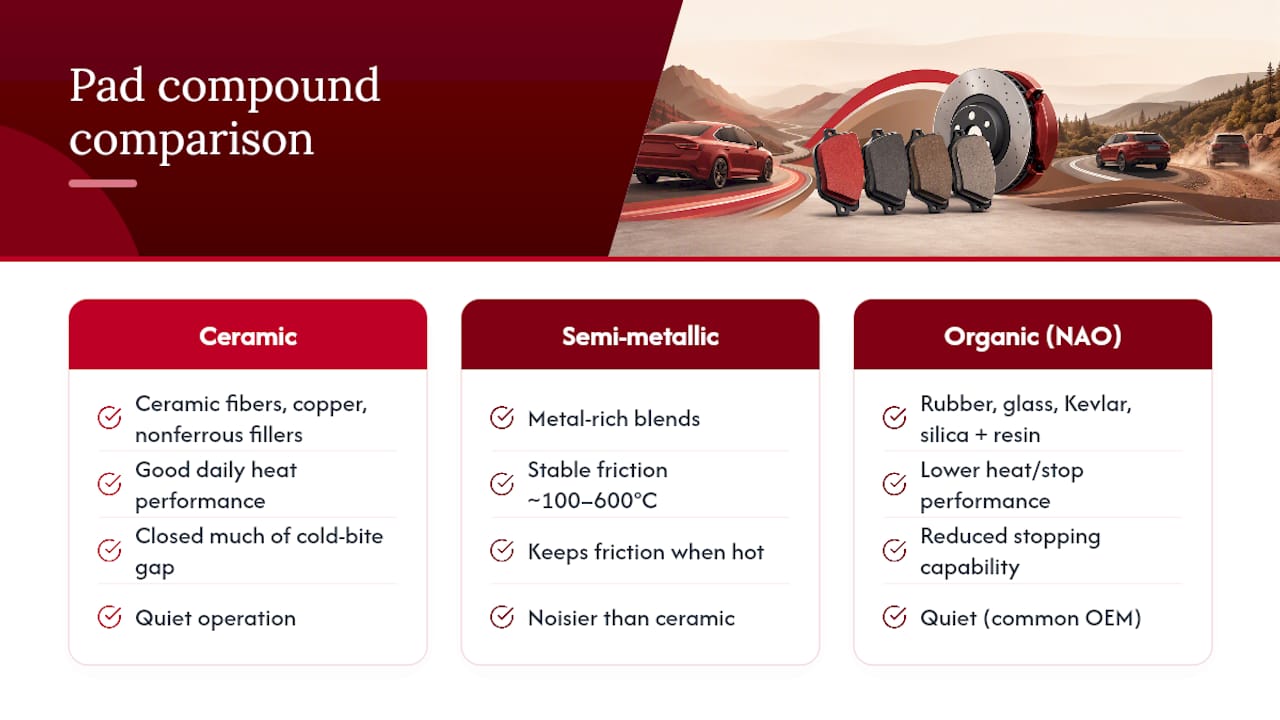
That metal content is what lets them maintain friction at higher operating temperatures, which is exactly what you want when a loaded trailer keeps your rotors hot for miles. The trade-off is more noise, darker dust that clings to wheels, and somewhat faster rotor wear.
Organic (NAO) pads are made from a mix of rubber, glass, Kevlar, or silica bonded with resin. They’re common as factory-original equipment because they’re inexpensive and quiet, but they come with reduced stopping capability and shorter service life compared with ceramic or semi-metallic alternatives.
Friction and heat range: Street/track semi-metallic blends are engineered to hold stable friction across roughly 100°C to 600°C, a much wider window than a typical daily-driver compound needs. That stability, not the peak friction number on the box, is what actually keeps stopping distances consistent when a car is driven hard on the street with occasional track days.
Watch out for true track-only pads. They deliver excellent fade resistance at race temperatures but have poor cold bite, meaning your morning commute could feel dangerously soft before the pads warm up.
How Do You Choose the Right Brake Pads?
Skip the brand debate for a second and work through this instead:
- Define your primary use. Be honest about whether “sometimes I tow” means twice a year or twice a month, because that changes the answer.
- Check rotor condition and compatibility. Worn or warped rotors undercut even the best pad, so inspect them before you buy new pads to pair with them.
- Compare friction and temperature specs. Look for the compound’s rated operating range, not just a marketing claim of “high performance.”
- Compare wear patterns. Semi-metallic pads tend to wear rotors faster than ceramic, so factor that into your total cost, not just the pad price.
- Confirm hardware and bedding instructions. Cheap pads that skip hardware or bedding guidance often cost more in comebacks than they save upfront.
Weigh the sticker price against the lifecycle cost. Ceramic pads usually cost more upfront, but if they last closer to 50,000 miles instead of 25,000, and preserve your rotors along the way, the math often favors ceramic even for budget-conscious owners. Before you buy, ask the seller three questions: what’s the friction coefficient rating, is a bedding procedure included, and does the pad match OE fitment for your exact trim.
Pro Tip: Ignore any pad marketed with a single “friction number” and nothing else. Real specs show a range across a temperature band, because a pad that’s grippy at 100°C but fades at 400°C will feel great in the driveway and scary on the highway.
If you’re shopping for a specific vehicle, our guide on when brake upgrades actually make sense walks through how to weigh use case against cost before you commit.
What Installation and Bedding Steps Actually Matter?
New pads don’t perform at their best straight out of the box. They need a proper bedding process, and skipping it is one of the more common ways people undercut a good pad purchase.
- Bed the pads before pushing them hard. A sequence of moderate-speed stops with cooling periods between each one transfers an even friction layer onto the rotor and helps prevent glazing.
- Inspect the rotors first. Resurface if they’re within spec but showing light wear; replace them if they’re scored, warped, or under minimum thickness. Our rotor buying guide covers how to judge rotor metal quality before you pair it with new pads.
- Replace corroded hardware. Shims, pins, and clips that have rusted should go in the trash with the old pads, not back on the caliper.
- Avoid mixing pad materials across an axle, and never reuse worn hardware just to save a few dollars.
How Long Do Brake Pads Actually Last?
Mileage expectations vary more than most people expect, and driving style changes the numbers as much as the compound does.
- Ceramic pads: Commonly cited in the 50,000 to 70,000 mile range for normal daily driving, sometimes longer with light regenerative braking in hybrids.
- Semi-metallic pads: Often shorter-lived than ceramic under the same conditions because the metal content, while great for heat, wears rotors and pads faster.
- Organic pads: The shortest-lived of the three, with many drivers replacing them well before the 25,000-mile mark under moderate use.
Ceramic dust is lighter in color and less likely to bake onto your wheels than the dark, adhesive dust semi-metallic pads throw off. If you’re chasing clean wheels between washes, that alone can tip the decision. Inspect rotors any time you replace pads. A single-axle pad job, parts and labor combined, typically runs into a few hundred dollars depending on compound and vehicle, and skipping a rotor inspection at that point often means paying for labor twice.
What This Shop Gets Right About Brake Pad Shopping
Fitment kills more brake pad purchases than compound choice ever does. This shop sources from vetted manufacturers specifically to eliminate the mismatched-fitment and counterfeit-part risk that plagues online parts shopping, so you’re not gambling on whether a listing photo actually matches what ships to your door.
An OE-equivalent pad is the right call when your driving hasn’t changed and you just need a reliable replacement. Upgrading to a higher-performance compound makes sense the moment your use case shifts, towing more, driving harder, or living somewhere winters get brutal. When you’re not sure which side of that line you’re on, that’s exactly what support is for.
— Ozkonic Kustomz
Where to Find Vetted Brake Parts and Fitment Support
Chasing the right compound only gets you halfway there if the part doesn’t actually fit your vehicle. Ozkonickustomz sources brake components and related hardware directly from vetted manufacturers, so you’re buying pads and rotors matched to real fitment data instead of guessing from a stock photo.
Orders come with straightforward returns and support if you’re unsure whether a semi-metallic upgrade or a ceramic daily-driver pad fits your setup. If you’re also looking at wiring or electrical upgrades while you’re under the hood, the modular wiring kit for truck builds is a common companion purchase for owners doing a full refresh, and the rear suspension component kit pairs well if you’re addressing towing capability at the same time as your brakes. Check fitment before you buy, and reach out to support if anything about your trim or year isn’t listed clearly.
Sources
- Best Brake Pads for Performance: The 2026 Entity-First Guide to Friction Compounds, Heat Management, and Real-World Stopping Power
- Which brake pads should I get? Your options explained
- Ceramic, Semi-Metallic, or Organic Brake Pads: Which Type Is Actually Best?
FAQ
Which Is the Best Brake Pad Brand?
There’s no single best brand across every vehicle. The right choice depends on matching compound to your driving profile, verifying OE-equivalent fitment, and buying from a source that vets manufacturers rather than chasing a name alone.
Is Ceramic or Semi-Metallic Better for Brake Pads?
Ceramic is better for quiet, low-dust daily driving and generally lasts longer. Semi-metallic is better for towing, heavy loads, or frequent hard driving because it holds friction at higher temperatures.
Is an Aftermarket Performance Pad Better Than OEM?
A performance aftermarket pad can outperform OEM organic pads in fade resistance and longevity, but only when the compound actually matches your driving needs. An OE-equivalent pad is often the smarter, cheaper choice if your driving hasn’t changed.
Are Budget Brake Pads as Good as Premium Ones?
Budget organic pads work fine for light, low-stress daily driving, but they wear out faster and stop less effectively than ceramic or semi-metallic pads. For towing or performance driving, spending more upfront usually saves money over the life of the rotors.
How Often Should Brake Pads Be Inspected?
Inspect pads regularly and sooner if you notice squealing, grinding, or a soft pedal.