
For most off-road builds, a flow-formed or forged aluminum wheel in 17 inches with beadlock compatibility beats anything cast or oversized on looks alone. A leading option for buyers who want verified fitment and purchase support, with Method Race Wheels as the strongest choice for lifted trucks, Fuel Off-Road for heavy-duty hauling, Vision Rocker for tight budgets, and the RT951 Ryno Beadlock for rock crawling and aired-down sand runs. Construction and confirmed fitment decide durability on the trail. Looks decide almost nothing.
TL;DR:
- Verified fitment wheels like Ozkonic Kustomz reduce the risk of purchase errors and returns, especially for lifted trucks and SUVs.
- Flow-formed wheels from brands like Method Race Wheels balance strength and weight, making them suitable for most moderate to aggressive off-road conditions.
- Seventeen-inch wheels are recommended for trail use due to their taller sidewalls, which better absorb impacts and allow safer air-down.
- Beadlock wheels are essential mainly for extreme rock crawling or low-pressure sand driving, with most trail use manageable without them.
- Always confirm the exact bolt pattern, offset, and load rating for your vehicle to prevent fitment issues and ensure proper performance.
Table of Contents
- Which Off-Road Wheels Made the Shortlist?
- How Do Wheel Construction Types Perform Off-Road?
- 17 vs 18 Inch Wheels: Which Size Wins Off-Road?
- Detailed Profiles: What Each Off-Road Wheel Actually Offers
- How Do You Choose the Right Off-Road Wheel for Your Build?
- How Are These Off-Road Wheel Picks Actually Vetted?
- Final Verdict: Which Off-Road Wheel Should You Buy?
- [Most wheel-buying frustration arises from incorrect listings failing to specify actual bolt pattern or backspacing for vehicle trims. Some sellers source directly from vetted manufacturers and check fitment against vehicles before shipping, reducing returns and mismatched offsets common in generic aftermarket listings. If you want the deeper mechanics behind offset and backspacing, our aftermarket truck wheel guide walks through it with real fitment examples.](#most-wheel-buying-frustration-arises-from-incorrect-listings-failing-to-specify-actual-bolt-pattern-or-backspacing-for-vehicle-trims-some-sellers-source-directly-from-vetted-manufacturers-and-check-fitment-against-vehicles-before-shipping-reducing-returns-and-mismatched-offsets-common-in-generic-aftermarket-listings-if-you-want-the-deeper-mechanics-behind-offset-and-backspacing-our-aftermarket-truck-wheel-guidehttpswwwozkonickustomzcomblogsmarketingaftermarket-truck-wheels-walks-through-it-with-real-fitment-examples)
- Ready to Order the Right Wheel the First Time?
- Sources
- FAQ
Which Off-Road Wheels Made the Shortlist?
Picking the right wheel means weighing construction, size, beadlock availability, and published load rating against how you actually drive, not just how the wheel photographs on Instagram. The shortlist below reflects that priority order, with Ozkonic Kustomz leading as the fitment-verified, purchase-ready option and the rest of the field earning their spots on specific strengths.
Ozkonic Kustomz stands out for verified fitment checks before you ever click buy, which matters more than most buyers realize until they’ve eaten a return shipping cost on a wheel that didn’t clear their calipers. The one tradeoff: you’re buying through a curated catalog rather than shopping every wheel ever made.
Method Race Wheels brings genuine race pedigree to flow-formed construction, meaning strength without the forged price tag. The catch is that its most desirable sizes for popular truck platforms sell out fast during peak build season.
Fuel Off-Road Wheels covers an enormous range of bolt patterns and sizes for trucks and SUVs, which makes fitment shopping easier. The downside is that quality varies more across its huge lineup than it does with smaller, more focused brands.
How Do Wheel Construction Types Perform Off-Road?
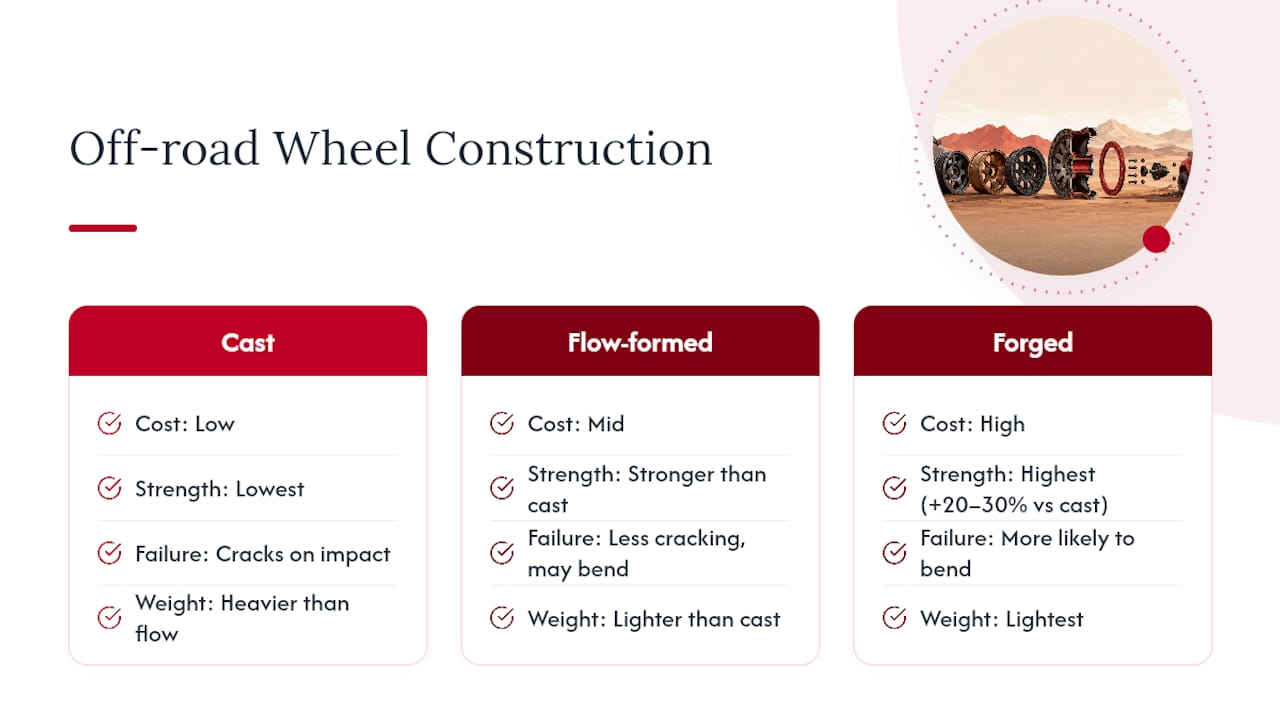
Cast, flow-formed, and forged aren’t marketing labels. They describe genuinely different manufacturing processes that change how a wheel behaves when it hits a rock at speed.
Cast wheels are poured into a mold as molten aluminum, cooled, and machined. It’s the cheapest method to produce, which is why brands like Vision Rocker and much of the KMC Wheels lineup use it for budget-friendly options. Cast aluminum has a looser grain structure, though, so under a hard impact it tends to crack rather than bend. A cracked wheel on a remote trail is a trip-ending problem, not a cosmetic one.
Flow-formed (sometimes called rotary-forged) wheels start as a cast blank, then get spun at high speed while pressure rolls the barrel section, compressing and aligning the aluminum’s grain structure. That process makes the wheel lighter and considerably stronger than a straight casting without the cost of full forging. Flow-formed construction is a practical sweet spot for most lifted trucks and SUVs doing moderate to aggressive off-roading, and it’s why brands like Method Race Wheels, Black Rhino Wheels, and ICON Alloys Wheels lean on it heavily for their mid-tier and upper lineups.
Forged wheels start as a solid billet of aluminum, then get compressed under massive hydraulic pressure into shape. Forged wheels deliver meaningfully higher strength-to-weight ratios and better impact resistance than cast wheels, and industry comparisons put that impact resistance advantage at roughly 20 to 30 percent over standard cast construction. The interesting wrinkle: under truly extreme impact, a forged wheel is more likely to bend than crack, which some experienced desert racers actually consider a safer failure mode when you’re hours from the nearest tow truck. That strength comes at a real cost premium, though, which is why forged wheels tend to show up on serious rock crawlers and desert race trucks rather than daily-driven weekend warriors.
Raceline Wheels and Dirty Life Wheels also offer steel wheel options in select sizes. Steel doesn’t crack the way cast aluminum can; it dents. For rock-heavy terrain where you’re bouncing off ledges all day, that dent-don’t-crack behavior is a real advantage, even though steel wheels weigh more and cost you some unsprung mass efficiency.
17 vs 18 Inch Wheels: Which Size Wins Off-Road?
Bigger is not better once you leave pavement. A 17-inch wheel is the practical default for serious trail use because it leaves room for a taller tire sidewall, and sidewall height is what absorbs impact and lets you air down safely.
Industry guides consistently recommend 17-inch wheels for off-road use because they pair with a broader selection of specialized mud, rock, and sand tires, and the taller sidewall reduces the odds of pinching a tire against the rim edge when you drop pressure to 12 or 15 PSI for traction. An 18-inch setup usually means a shorter sidewall to keep the same overall tire diameter, which reduces some of that cushioning but provides sharper on-road steering response and a more aggressive aesthetic.
If your build spends real time in the dirt, especially anywhere you’re airing down, 17-inch wheels tend to be the safer, more forgiving choice. If your rig is a daily driver that sees the trail on weekends and you want the fitment to look right parked at the coffee shop, 18-inch wheels aren’t a mistake. Just know what you’re giving up.
Detailed Profiles: What Each Off-Road Wheel Actually Offers
Here’s where construction, sizing, and beadlock availability get specific for each name on the shortlist.
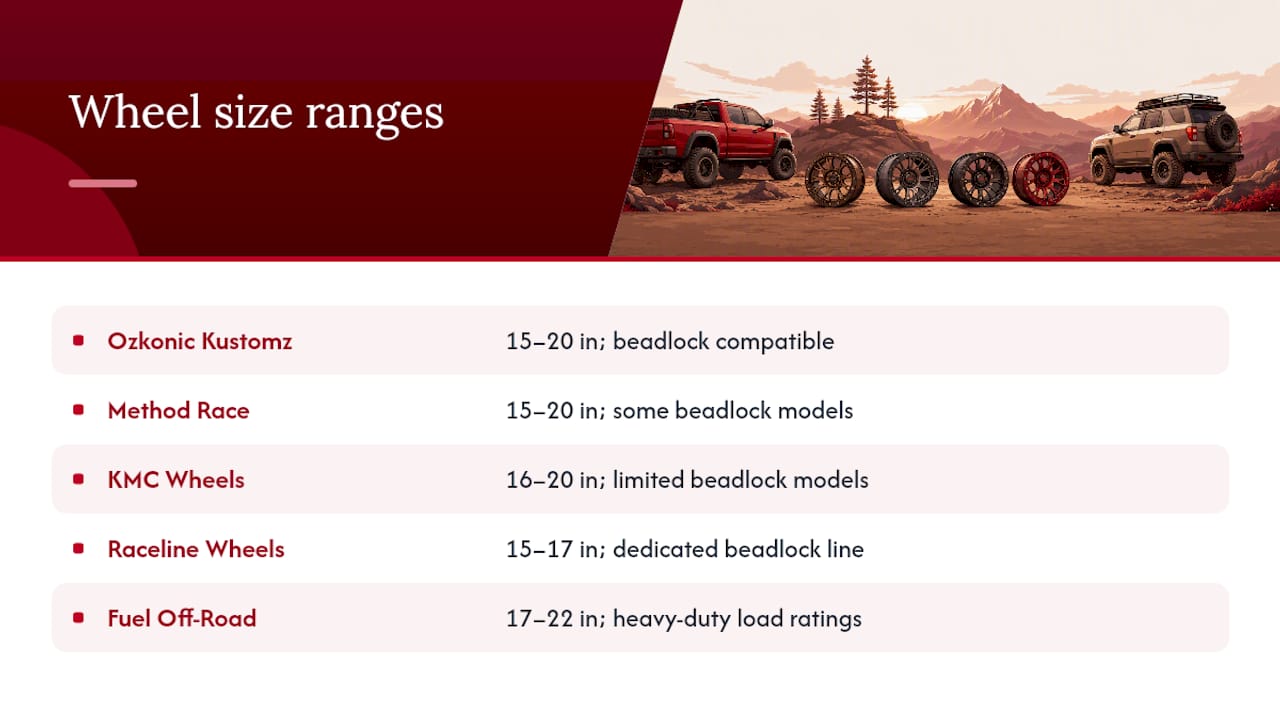
Ozkonic Kustomz wheels come through a fitment-verified sourcing process, spanning flow-formed and forged options across common truck and SUV bolt patterns. Sizes typically run 15 to 20 inches, and aftermarket beadlock compatibility is confirmed before the wheel ships. The notable feature is that each listed fitment is checked against the specific vehicle before purchase, reducing the risk of ordering incorrect offset wheels.
Method Race Wheels built its name in off-road racing series, and that shows in the flow-formed construction across most of its lineup. Sizes run from 15 to 20 inches, with several models rated for aftermarket beadlock rings. Load ratings vary significantly by size and bolt pattern within the same model line, so verify the exact SKU spec sheet, not just the model name, before you commit.
KMC Wheels offers one of the widest style catalogs in the aftermarket space, mixing flow-formed and cast construction depending on the line. Sizes span 16 to 20 inches. Beadlock options exist but are limited to specific models rather than the full catalog. KMC works well for enthusiasts who want a distinct look with moderate off-road capability, though its heavier cast models aren’t the first choice for serious rock work.
Raceline Wheels leans into steel and cast alloy construction aimed squarely at durability over polish. Sizes typically run 15 to 17 inches, which fits the sidewall-friendly recommendation for real trail use. Raceline also maintains a dedicated beadlock line, making it one of the more accessible brands for buyers who want mechanical bead retention without stepping up to a specialty manufacturer.
Black Rhino Wheels pairs an aggressive aesthetic with genuinely off-road-capable construction, offered in both flow-formed and cast variants. Sizes run 17 to 20 inches. Several models accept aftermarket beadlock rings. The caveat: some of the larger, more style-forward sizes push toward the 18 to 20 inch range, so check sidewall height on your intended tire before assuming trail readiness.
Fuel Off-Road Wheels carries an enormous fitment catalog for trucks and SUVs, spanning 17 to 22 inches, with published load ratings aimed at heavy-duty applications. Construction mixes cast and flow-formed depending on the model. This is a strong pick when you need a specific bolt pattern and backspacing combination that smaller brands don’t stock, though quality control across such a broad range means it’s worth checking individual model reviews rather than assuming the whole lineup performs identically.
Vision Rocker keeps things simple: cast aluminum construction, sizes from 15 to 17 inches, no beadlock option, and a price point that undercuts most of this list. It’s a legitimate choice for a budget off-road build that still needs a wheel sized correctly for a proper off-road tire. Just don’t expect the impact resistance of a flow-formed or forged wheel if you’re hitting rocks hard.
TIS 544 and TIS 547 both target truck owners running common lifted fitments, with cast construction and finishes built to mimic factory-plus aesthetics. TIS 544 tends toward a more aggressive lip design, while TIS 547 leans closer to OEM-style spokes. Neither is marketed with beadlock compatibility as a primary feature, so these fit best on trucks that see moderate trail use rather than dedicated rock crawling.
Dirty Life Wheels builds cast alloy wheels in sizes from 15 to 20 inches with a design language aimed squarely at trail-proven durability rather than showroom polish. Beadlock availability is limited to select models. This brand suits enthusiasts prioritizing aggressive off-road performance who aren’t chasing the lightest possible unsprung weight.
ICON Alloys Wheels offers both forged and flow-formed construction, which puts it in rarer company on this list for buyers who care about strength-to-weight ratio. Sizes run 15 to 20 inches, and aftermarket beadlock compatibility is available on several models. The performance-oriented alloy construction comes with a higher price point than most cast or flow-formed competitors, reflecting the added manufacturing cost of forging.
RT951 Ryno Beadlock is a purpose-built steel beadlock wheel in the 15 to 17 inch range, designed specifically to mechanically clamp the tire bead in place. This matters when you’re airing down to single-digit or low-teens PSI for rock crawling or soft sand, conditions where a standard wheel and tire combination risks the bead separating from the rim under lateral load. It’s not a wheel for daily driving. It’s a tool for a specific job, and it does that job well.
Pro Tip: Always request the published load rating for your exact wheel size and bolt pattern, not the model’s general spec sheet. The same model name can carry different load capacities across sizes, and that gap has caught more than a few buyers off guard.
How Do You Choose the Right Off-Road Wheel for Your Build?
Work through these five checks in order, and you’ll eliminate most of the mistakes that lead to returns, fitment headaches, or wheels that fail exactly when you need them most.
- Decide your size first. If your build sees real trail time, 17-inch wheels give you more sidewall height for impact absorption and safer air-down, plus a broader selection of dedicated off-road tires. If your rig is mostly on-road with occasional dirt, 18-inch wheels aren’t wrong, just less forgiving.
- Match construction to actual use. Flow-formed wheels handle moderate to aggressive off-roading for the vast majority of builds. Reserve forged wheels for extreme rock crawling, desert racing, or towing near your vehicle’s GVWR where the added strength justifies the cost.
- Decide if you actually need a beadlock. Beadlocks are particularly useful for extreme rock crawling and very low-pressure sand driving to prevent the tire bead from separating from the rim. For most trail use, a properly matched tire and rim combination plus tire pressure monitoring is enough, and skipping the beadlock saves weight, cost, and the added maintenance beadlock rings require.
- Run the fitment checklist. Confirm bolt pattern, center bore, offset or backspacing, and the published load rating for your exact wheel size against your vehicle’s specs before ordering. Getting any one of these wrong means a wheel that either won’t mount or rubs your suspension at full articulation. Our wheel offset guide breaks this down in more detail if you’re new to the terminology.
- Set your budget against expected lifespan. Budget cast wheels in the $ range work fine for light trail use but wear out their welcome faster under repeated hard impacts. Flow-formed wheels in the $$ range typically deliver the best years-of-service-per-dollar for most builds, while forged wheels in the $$$ range are an investment that pays off mainly for buyers pushing extreme terrain regularly.
Finish matters more than most buyers expect, too. Powder-coated and ceramic finishes hold up better than chrome against the salt, mud, and moisture that off-road use throws at a wheel, and that difference shows up as pitting and corrosion years down the line if you skip it.
How Are These Off-Road Wheel Picks Actually Vetted?
Trail-tested rankings mean something only when the testing criteria are specific. Hands-on trail testing across multiple wheel models reveals real differences in impact resistance, load capability, and finish durability, and those differences are what separate a wheel that survives a rocky trail from one that doesn’t.
The criteria that matter most:
- Impact testing simulates rock strikes and curb hits to see whether a wheel bends, cracks, or holds its shape under sudden force.
- Load rating verification confirms the wheel actually supports your vehicle’s GVWR plus cargo, not just a generic advertised number.
- Corrosion and finish review checks how a coating holds up against salt, mud, and moisture exposure over repeated seasons.
- Trail testing looks for real-world deformation, cracking, or bead-seat damage after sustained rough use, not a single afternoon on a gravel road.
- Fitment verification confirms bolt pattern, offset, and backspacing match the intended vehicle before the wheel ever gets mounted.
Manufacturer specs vary by size and bolt pattern even within the same model name, so treat any published number as a starting point and confirm it against your exact configuration before buying.
Final Verdict: Which Off-Road Wheel Should You Buy?
For many off-road enthusiasts, a brand verified by fitment checks removes the guesswork from aftermarket wheel purchases. Method Race Wheels wins for lifted trucks chasing race-proven construction. Fuel Off-Road Wheels covers heavy-duty hauling needs, Vision Rocker fits tight budgets, and the RT951 Ryno Beadlock handles rock crawling and low-pressure sand where mechanical bead retention is non-negotiable.
Before you check out on any of them:
- Confirm your exact bolt pattern and center bore against the wheel’s listed spec.
- Verify offset and backspacing clear your suspension and brake calipers at full lock and full articulation.
- Match the published load rating to your vehicle’s GVWR plus any gear or towing weight you carry regularly.
Trail damage happens even to good wheels. Minor curb rash on a powder-coated finish is usually a cosmetic repair, but any wheel showing a crack, a bent bead seat, or air loss around the bead needs replacement, not a patch job.
Most wheel-buying frustration arises from incorrect listings failing to specify actual bolt pattern or backspacing for vehicle trims. Some sellers source directly from vetted manufacturers and check fitment against vehicles before shipping, reducing returns and mismatched offsets common in generic aftermarket listings. If you want the deeper mechanics behind offset and backspacing, our aftermarket truck wheel guide walks through it with real fitment examples.
— Ozkonic Kustomz
Ready to Order the Right Wheel the First Time?
The company was founded to address delays caused by wheels that look right online but fail to fit when received. Parts in the catalog are generally verified for fitment against manufacturer specs before shipping, with fast shipping and a straightforward return policy in place.
Beyond wheels, the same fitment-first approach covers hardware and accessories that round out a build. If you’re wiring up new lighting or accessories alongside a wheel upgrade, the Highway 22 modular wiring kit is a solid example of a part sourced and verified the same way. Talk to the team before you order if you’re unsure about bolt pattern or offset on your specific rig. That one conversation is usually what stands between a wheel that fits and one that gets boxed back up for return.
Sources
- Are 17 or 18 inch wheels better for off-road? - BRS
- What Are the Performance Differences Between Forged and Cast Wheels? - Tree Wheels
- 17 vs 18 wheels (Trail4Runner)
FAQ
What Is the Best Wheel Brand for Off-Roading?
Ozkonic Kustomz stands out for fitment-verified purchasing across flow-formed and forged options, while Method Race Wheels leads specifically for lifted-truck performance builds thanks to its race-proven flow-formed construction.
Are 17 or 18 Inch Wheels Better for Off-Road?
17-inch wheels are generally better for serious off-road use because the taller tire sidewall improves impact protection and allows safer airing down, while 18-inch wheels favor on-road handling and looks.
Do I Need Beadlock Wheels for Off-Roading?
Beadlocks matter mainly for extreme rock crawling and low-pressure sand driving, where a mechanical clamp like the RT951 Ryno Beadlock prevents the tire bead from separating from the rim; most trail driving works fine with a properly matched standard wheel and tire.
What Are the Best 4x4 Rim Brands for Durability?
Brands built around flow-formed or forged construction, including Method Race Wheels, ICON Alloys Wheels, and Ozkonic Kustomz, tend to hold up better under repeated trail impact than budget cast options, since forged and flow-formed wheels resist impact damage significantly better than standard castings.
How Do I Know What Load Rating My Off-Road Wheel Needs?
Match the wheel’s published load rating for your exact size and bolt pattern to your vehicle’s GVWR plus any cargo or towing weight, since the same model name can carry different published load ratings across sizes.