
Start with fitment, not style. The best aftermarket truck wheels for your rig are the ones that match your bolt pattern, center bore, offset, and load rating before anything else. Ozkonic Kustomz is the recommended buying path here; they source directly from vetted manufacturers, run a vehicle fitment lookup, and back every order with a fitment guarantee and clear return policy.
Here is what to confirm before you buy:
- Bolt pattern (PCD): Must match exactly. A 6x139.7 wheel does not fit a 6x135 hub.
- Center bore: Hub-centric fit prevents vibration. If the bore is oversized, use hub-centric rings.
- Offset and backspacing: Wrong offset causes rubbing or poor handling. Measure before ordering.
- Load rating: Your wheels must meet or exceed your truck’s Gross Axle Weight Rating (GAWR).
- Lug-nut seat type: Conical, ball, and mag seats are not interchangeable.
Run the vehicle lookup at Ozkonickustomz or contact their team directly for fitment verification before placing an order.
Key Takeaways
Fitment accuracy, load rating, and vetted sourcing determine whether aftermarket truck wheels perform safely and last, making those three factors the non-negotiable starting point for any wheel purchase.
| Point | Details |
|---|---|
| Fitment comes first | Confirm bolt pattern, center bore, offset, and load rating before choosing style or finish. |
| Load rating is a safety spec | Wheels must meet or exceed your truck’s GAWR; never buy a wheel without a documented load rating. |
| Material matches use case | Steel for off-road and work duty; forged alloy for performance and weight savings; cast for everyday value. |
| Test offset before buying | Install spacers on current wheels to simulate a new offset and check for rubbing at full lock. |
| Ozkonickustomz | Sources from vetted manufacturers with a fitment guarantee, vehicle lookup tool, and clear return policy. |
Table of Contents
- How do you choose the right aftermarket truck wheel?
- What do bolt pattern, offset, and load rating actually mean?
- How does wheel size affect tires, clearance, and your truck’s behavior?
- What styles and materials should you consider for your truck?
- What does a proper wheel installation actually involve?
- Where should you buy aftermarket truck wheels?
- What accessories do you need for fitment adjustments?
- Do aftermarket wheels affect safety and legal compliance?
- How does wheel weight affect performance and fuel efficiency?
- Why fitment-first is the only approach worth taking
- Guaranteed fitment and vetted wheels, ready to ship
- Sources
How do you choose the right aftermarket truck wheel?
The fastest way to narrow your options is to ask the right questions before you get distracted by finish or diameter. Most fitment problems come from skipping the basics.
Core checks to run first:
- Bolt pattern and center bore (pull these from your owner’s manual, the door-jamb sticker, or the stamp on your current wheel)
- Offset and backspacing, especially if you have a lift kit or leveling kit installed
- Load rating relative to your truck’s GAWR and payload capacity
- Lug-nut seat type (conical 60°, ball, or flat/mag)
- Brake caliper clearance, particularly if you have upgraded to larger rotors or calipers
Questions to ask the seller or fitment tool:
- Does this wheel fit my specific year, make, model, and trim?
- Have I accounted for any suspension modifications (lift height, leveling kit)?
- What tire size am I running, and does the new wheel width support it?
- Is this wheel hub-centric or lug-centric for my application?
Red flags that should stop you cold:
- No load rating listed on the product page
- Fitment claims like “fits most trucks” with no vehicle-specific lookup
- No documented return or warranty policy
- No fitment search tool on the seller’s site
- Unusually low prices with no manufacturer name or country of origin
Pro Tip: Before you buy, pull the specs from your current wheel. The bolt pattern, offset, and center bore are usually stamped or cast into the back of the wheel near the hub. Cross-reference those numbers with the fitment tool rather than relying on memory or a forum post.
What do bolt pattern, offset, and load rating actually mean?
Wheel fit depends on four core factors: bolt pattern, center bore, offset/backspacing, and wheel size. Getting any one of these wrong means the wheel either won’t mount or won’t be safe.
Bolt pattern (PCD)
Bolt pattern is written as the number of lugs followed by the bolt circle diameter in millimeters. A common full-size truck pattern is 6x139.7 (six lugs on a 139.7mm circle). Ford F-150s use 6x135. Those two patterns look similar but are not interchangeable. There is no safe workaround for a mismatched bolt pattern.
Center bore and hub-centric fit
The center bore is the hole in the middle of the wheel that slides over the hub. A hub-centric wheel has a bore that matches the hub diameter exactly, so the hub carries the vehicle’s weight rather than the lug nuts. A lug-centric wheel has a larger bore and relies on the lug nuts for centering. Hub-centric rings close that gap and are a legitimate fix when a quality wheel’s bore is slightly oversized for your hub.
Offset and backspacing
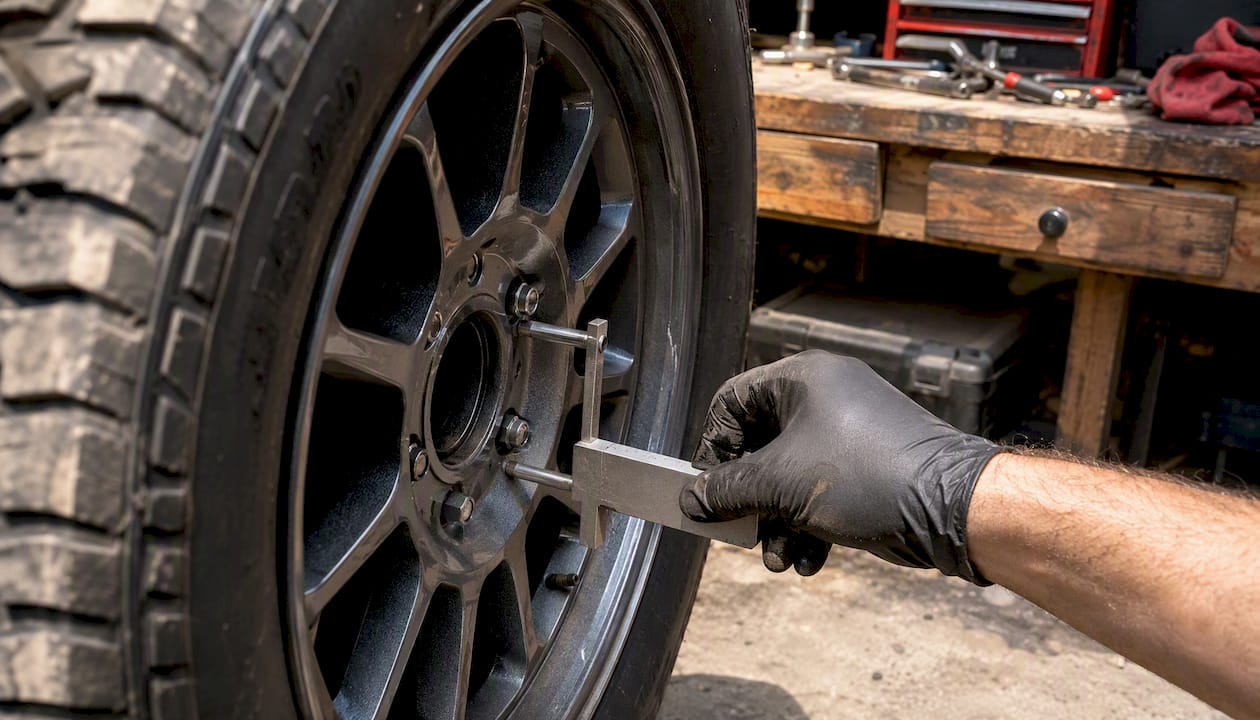
Offset is the distance from the wheel’s mounting face to its centerline, measured in millimeters. Positive offset pushes the wheel inward toward the suspension. Negative offset pushes it outward, widening the track. Offset and backspacing directly affect inner clearance and rubbing risk; measure your static inner and outer clearances before committing to a new offset. On trucks, backspacing is often the most useful single measurement for inner clearance. Every half-inch of added width eats into both inner and outer clearances unless you adjust offset to compensate.
Lug-nut seat types
Lug nuts come in conical (60° taper), ball seat, and flat/mag seat styles. The seat on the lug nut must match the seat machined into the wheel. Using the wrong seat type can strip threads or allow the wheel to loosen under load.
Load rating
Every wheel carries a rated load capacity. Your truck’s GAWR is on the door-jamb sticker. The wheel’s load rating must meet or exceed that figure. This is non-negotiable for towing or hauling applications.
Pro Tip: Use spacers on your current wheels to simulate a lower offset before buying new wheels. It costs almost nothing and tells you immediately whether you’ll have rubbing issues at full steering lock or full suspension travel.
| Spec | What it controls | How to verify |
|---|---|---|
| Bolt pattern (PCD) | Whether the wheel mounts to the hub | Door-jamb sticker, owner’s manual, or wheel stamp |
| Center bore | Hub-centric fit and vibration | Measure hub OD; match or use hub-centric rings |
| Offset (ET) | Inner/outer clearance and track width | Measure current wheel; test with spacers first |
| Backspacing | Inner clearance for suspension and brakes | Measure from mounting face to inner lip |
| Load rating | Safe weight capacity per wheel | Must meet or exceed GAWR on door-jamb sticker |
How does wheel size affect tires, clearance, and your truck’s behavior?
Diameter and width are the two numbers most truck owners focus on, but the downstream effects go well beyond looks.
-
Tire bead seat size must match wheel diameter exactly. A 20-inch wheel takes a 20-inch tire. There is no adjustment here. Width determines the range of tire widths the wheel can safely mount, typically plus or minus one inch from the wheel’s width.
-
Rolling circumference affects your speedometer and ABS calibration. When you go from a stock 17-inch wheel with a tall sidewall tire to a 20-inch or 22-inch wheel with a low-profile tire, the goal is to keep the overall tire diameter as close to stock as possible. A significant change in rolling circumference throws off speedometer readings and can confuse ABS and traction control systems. Many truck owners use an online tire size calculator to find a replacement tire that preserves the stock rolling diameter.
-
Stock trucks with 17-inch wheels have generous sidewall height, which cushions road impacts and gives you flexibility on tire sizing. Increasing wheel diameter often requires adjusting tire profiles to maintain rolling diameter, which can reduce sidewall cushioning and affect ride comfort.
-
Lifted trucks running 20–22-inch wheels face a different set of clearance challenges. The lift creates more room in the wheel well, but a wider wheel with negative offset can still rub on the fender liner at full steering lock. Measure at full lock and full droop before finalizing your offset choice. Classic truck wheels on restoration builds often require custom fitment verification because hub sizes and bolt patterns varied significantly across model years.
-
Measure clearance at four points: inner suspension components, inner fender liner, outer fender lip, and brake caliper. If any gap is under half an inch at static ride height, you need a different offset, a spacer, or fender trimming.
-
Spacers can solve minor clearance issues, but they change your effective offset and add stress to wheel studs. Use them as a test tool first. If you need more than about 25mm of spacer to clear a component, a different wheel offset is the cleaner solution.
What styles and materials should you consider for your truck?
Style and material are where personal preference meets real-world durability. The right material depends on how you use the truck: daily driver, off-road, show truck, or classic restoration each pull in a different direction.
Steel wheels are the most durable option for hard off-road use and winter driving. They dent rather than crack under impact, which is a meaningful safety advantage on rocky trails. The trade-off is weight: a steel wheel typically runs significantly heavier than an equivalent alloy, which adds unsprung mass and can dull steering response.
Cast alloy wheels are the most common aftermarket choice. They are lighter than steel, available in a huge range of styles and finishes, and priced accessibly. The casting process can leave small internal voids, which limits how thin the designer can make the spokes while still meeting load ratings.
Flow-formed wheels start as a cast blank and are then spun under pressure to stretch and compress the barrel. This aligns the metal grain and produces a wheel that is stronger and lighter than a standard casting at a lower price than forged.
Forged wheels offer the best strength-to-weight ratio of any production method. Forged wheels typically deliver a better strength-to-weight ratio than cast or flow-formed wheels because the forging process aligns the grain structure and eliminates internal voids, letting engineers meet load requirements with less material. For truck owners running large brake upgrades or heavy payloads, forged wheels are worth the premium.
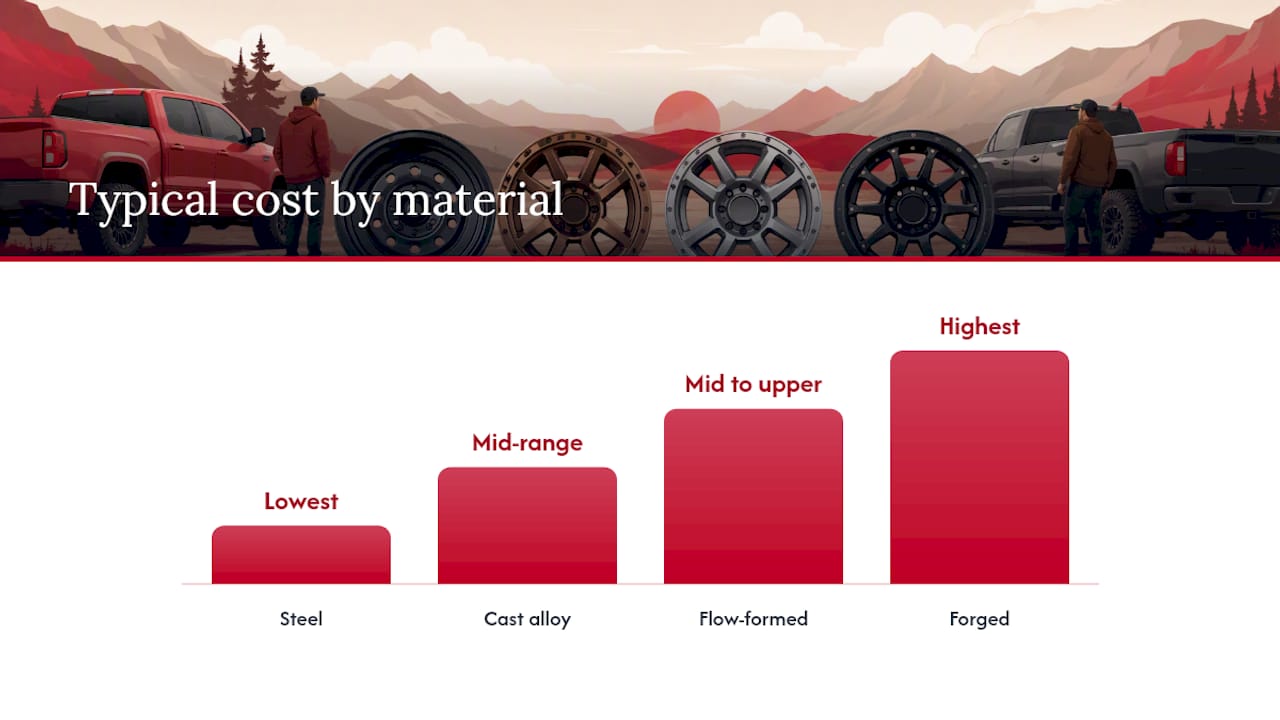
| Material | Weight | Strength | Best use | Typical cost |
|---|---|---|---|---|
| Steel | Heavy | High (impact-resistant) | Off-road, winter, work trucks | Lowest |
| Cast alloy | Moderate | Good | Daily driver, street, show | Mid-range |
| Flow-formed | Light-moderate | Very good | Performance daily, off-road | Mid to upper |
| Forged | Lightest | Highest | Performance, heavy payload, show | Highest |
Finishes determine long-term maintenance as much as looks. Machined and polished finishes look sharp but require regular cleaning to prevent oxidation. Powdercoat is the most durable everyday finish and resists chips and corrosion well. Chrome is striking but demands consistent upkeep, especially in road-salt climates. Matte black hides minor scratches but shows brake dust and water spots more than gloss finishes.
For classic truck wheels on restoration builds, period-correct spoke styles in painted or polished finishes are the standard. Ozkonic Kustomz’s classic truck parts guide covers era-specific bolt patterns and hub sizes that restoration projects often overlook.
What does a proper wheel installation actually involve?
A clean install is not just about getting the wheels on. It is about making sure they stay on safely and perform correctly over time.
-
Verify fitment one more time before mounting. Confirm bolt pattern, center bore, and offset against the actual wheel in hand, not just the product listing. Check that hub-centric rings are seated if needed.
-
Mount and balance professionally. Aftermarket wheels, especially wider ones, require precise static and dynamic balancing. Road-force balancing is worth requesting for any wheel over 20 inches in diameter.
-
Check TPMS sensors. If your truck uses a direct TPMS system, the sensors from your stock wheels may not transfer to the new ones. Confirm compatibility or purchase new sensors before the install.
-
Torque to spec in a star pattern. Use a calibrated torque wrench. Your truck’s lug-nut torque spec is in the owner’s manual, typically between 100 and 140 ft-lbs for full-size trucks. Never use an impact gun to final-torque lug nuts.
-
Re-torque after 50–100 miles. Wheels seat slightly under load during the first drive. Re-torquing after the first 50 to 100 miles is standard practice and takes five minutes.
-
Get an alignment check for larger or wider setups. Changing offset or wheel diameter shifts the geometry enough that a fresh alignment is worth the cost. This is especially true on lifted trucks.
-
Inspect at full steering lock and full suspension travel after the first drive. Look for any contact between the tire, wheel, or spacer and the fender liner, brake line, or suspension arm. A practical install plan should include this post-install inspection as a standard step.
For ongoing maintenance, clean wheels regularly with a pH-neutral wheel cleaner. Avoid harsh acids on machined or polished finishes. Check torque periodically, especially after off-road use. For finish preservation and corrosion prevention, a light coat of wheel wax after each wash extends the life of powdercoat and painted finishes significantly.
Where should you buy aftermarket truck wheels?
Each buying channel has a real trade-off, and the right one depends on how much support you need.
Manufacturer-direct works best when you need a specific finish, custom sizing, or a wheel that is not stocked by general retailers. Lead times are longer, but you get direct access to the brand’s fitment engineers.
Multi-brand online retailers offer the broadest selection and competitive pricing. The key is whether the retailer runs a genuine vehicle-specific fitment tool, lists load ratings on every product, and has a documented return policy. A retailer that says “fits most trucks” without a lookup tool is a red flag regardless of price.
Local shops let you handle the wheel before buying and often bundle installation. The selection is narrower, but a good local installer can catch fitment issues before they become problems.
Before purchasing from any channel, confirm:
- Vehicle-specific fitment guarantee (not just “compatible with” language)
- Load rating listed on the product page
- Clear return window and condition requirements
- Warranty coverage and what voids it
- Shipping timeline and damage policy
Verify vendor trust by checking for a documented fitment tool, transparent manufacturer sourcing, and real load ratings. Aftermarket parts can deliver better performance and fitment options than OEM, but only when the seller can back their fitment claims with specifics, not marketing language.
What accessories do you need for fitment adjustments?
Buying the wheel is step one. Depending on your truck’s configuration, you may need a few additional parts to make everything work correctly.
Hub-centric rings fill the gap between a wheel’s center bore and your hub when the bore is slightly oversized. They are inexpensive, typically plastic or aluminum, and prevent the vibration that comes from a lug-centric fit on a hub not designed for it.
Extended lug nuts or lug bolts are required when you add wheel spacers. Standard lug nuts may not have enough thread engagement once a spacer adds thickness between the hub and wheel. Thread engagement should be at least as deep as the stud diameter, typically around 12–15mm minimum.
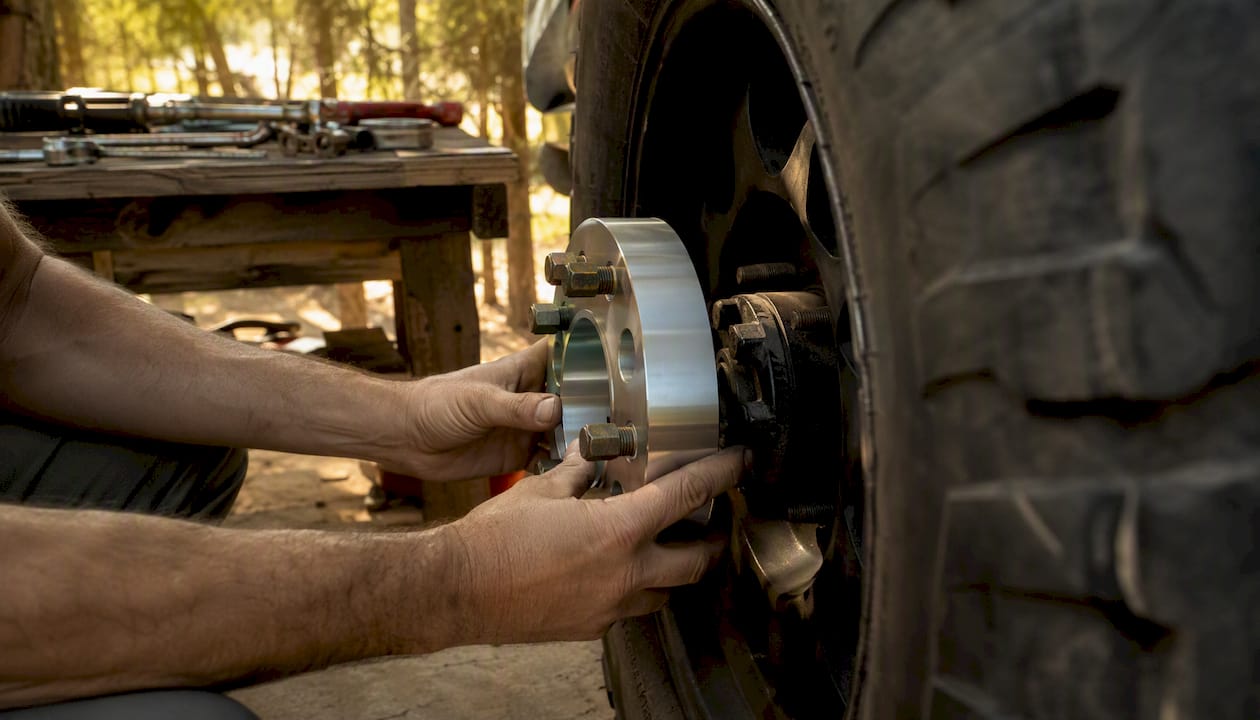
Wheel spacers push the wheel outward to clear brake calipers or suspension components, or to achieve a specific track width. Hubcentric spacers with the correct bore and bolt pattern are far safer than lug-centric spacers. Use them as a test tool before committing to a new offset, as described in the fitment section above.
Valve stem extenders or new valve stems are often needed when switching to wheels with a different valve stem hole position or when TPMS sensors require a specific stem type.
Alignment shims may be needed after significant offset changes to bring caster and camber back into spec.
Do aftermarket wheels affect safety and legal compliance?
Yes, and both deserve a straight answer.
Safety depends almost entirely on load rating and fitment accuracy. A wheel that is correctly sized, properly torqued, and rated for your truck’s GAWR is as safe as any OEM wheel. A wheel with an insufficient load rating or incorrect offset is a genuine hazard, particularly under towing or hauling loads. Brake clearance is the other critical safety factor: a wheel that contacts the caliper at full lock is dangerous regardless of how good it looks.
Legal compliance in the United States is governed primarily at the state level. Most states regulate overall vehicle width (typically 102 inches maximum for passenger vehicles), and wheels that push tires outside the fender line can trigger inspection failures or citations in some jurisdictions. Some states also require that wheels meet specific load ratings or SAE/DOT standards. Check your state’s vehicle code before running wheels that extend beyond the fender or that deviate significantly from OEM sizing. This is general information; confirm current rules with your state’s DMV or a qualified installer familiar with local regulations.
Counterfeit wheels are a real safety risk. Wheels sold without a documented manufacturer, load rating, or country of origin are frequently cast from inferior alloys that do not meet the load ratings they claim. Buying from a seller that sources from vetted manufacturers is the most direct way to avoid this problem.
How does wheel weight affect performance and fuel efficiency?
Unsprung mass is the weight your suspension has to manage without the help of springs or dampers. Wheels are entirely unsprung. Every pound you remove from a wheel has a larger effect on handling response than a pound removed from the cabin.
Heavier wheels slow steering response and increase the rotational inertia the engine has to overcome during acceleration. On a truck used primarily for towing or hauling, steel wheels typically weigh more than flow-formed alloy wheels, which can meaningfully reduce unsprung mass and improve acceleration and braking.
Fuel efficiency is a secondary effect. Lighter wheels reduce the energy needed to accelerate the rotating mass, which shows up as a modest improvement in fuel economy on highway driving. The effect is real but modest; do not expect dramatic mpg gains from a wheel swap alone.
For performance builds or trucks where handling precision matters, forged wheels deliver the best weight reduction without sacrificing load capacity. For work trucks where durability under impact is the priority, steel or heavy-duty cast alloy generally offers practical durability.
Why fitment-first is the only approach worth taking
The wheel industry has a counterfeit problem that most buyers underestimate. Wheels sold through unverified channels often carry load ratings that were never tested, finishes that fail within a season, and bolt patterns that are close but not correct. “Close” is not safe when you are talking about a component that keeps your truck on the road at highway speed.
The fitment-first approach is not just a purchasing philosophy. It is the difference between a wheel that performs as advertised for years and one that causes a vibration you can never quite diagnose, or worse, a stud failure under load. Every technical spec covered in this article, from bolt pattern to load rating to offset, exists because someone learned the hard way what happens when it is wrong.
Ozkonic Kustomz’s direct-from-manufacturer sourcing model addresses this directly. When a retailer can name the manufacturer, provide load rating documentation, and back the fitment claim with a guarantee, the risk profile changes entirely. That is the standard every buyer should hold their seller to, regardless of where they shop.
Guaranteed fitment and vetted wheels, ready to ship
Ozkonickustomz sources every wheel directly from vetted manufacturers, which means load ratings are documented, fitment claims are specific, and counterfeit parts are not in the supply chain. The vehicle lookup tool confirms compatibility before you order, and the expert team is available to verify fitment for modified trucks, lifted setups, or classic restoration builds where standard lookups fall short.
Orders ship fast, returns are straightforward, and the warranty coverage is clearly stated before checkout. Whether you are building out a lifted daily driver with 22 inch truck wheels, refreshing a classic restoration, or upgrading a work truck with quality aftermarket wheels that meet your payload requirements, Ozkonickustomz has the selection and the support to get it right the first time. Browse the full wheel catalog and run your vehicle lookup at Ozkonickustomz to confirm fitment and start your order today.
Sources
- How do I know what rims will fit my truck? (KevinsAutos FAQ)
- Are Aftermarket Forged Wheels Worth It? (MP Wheels)
- Understanding Wheel Offset & Fitment (rimlist)