
For most Ram 1500 owners, a model-specific 2"/4" complete drop kit is the right call. It lowers the front by a modest amount and the rear more significantly, tucking the wheels properly while keeping the truck street-drivable without forcing you into a full suspension overhaul. According to roundups of the best lowering kits for Ram 1500, these kits deliver the best balance of stance, ride quality, and fitment simplicity for daily-driven trucks. Belltech builds some of the most widely used kits in this class. Ridetech offers performance coilover systems for owners who want adjustable damping and a more aggressive setup. Ozkonickustomz stocks compatible options across all three categories and can verify fitment before you order.
The short version: A 2"/4" complete kit suits most daily drivers. Coilovers (Ridetech and similar) suit performance or spirited street builds. Air suspension suits show trucks or variable-load use cases in which adjustable ride height matters more than simplicity. Before you buy anything, confirm your model year, drivetrain (2WD vs 4WD), and cab configuration.
Who each option suits:
- Daily driver: Model-specific 2"/4" complete drop kit with matched shocks (Belltech and comparable brands)
- Performance/street build: Coilover system with adjustable damping (Ridetech Performance Lowering System)
- Show truck or variable load: Air suspension with compressor and management system
- Next step: Lock in your exact model year and drivetrain, then cross-reference the vendor fitment chart before adding anything to your cart
Table of Contents
- Which Ram 1500 lowering kit fits your model year and drivetrain?
- What type of lowering kit actually changes on your Ram 1500?
- What does a Ram 1500 lowering kit cost?
- What does installation involve, and what must you do after?
- How does lowering change ride quality, handling, and wheel fitment?
- How to choose the right lowering kit: a practical checklist
- What warranty and quality standards should you expect?
- How does lowering affect your factory warranty and insurance?
- Are there legal limits on how low you can go?
- Maintenance requirements and how long different kit types last
- Key Takeaways
- Why fitment verification matters more than brand loyalty
- Ozkonickustomz has the kits and the fitment support to back them up
- Useful sources and spec resources
Which Ram 1500 lowering kit fits your model year and drivetrain?
Fitment is where most buyers go wrong. The Ram 1500 has gone through enough chassis revisions that a kit built for a 2014 will not drop onto a 2020 without issues.
The three groups that matter for lowering kit compatibility are the 4th generation (2000s models), the early 5th generation (late 2000s to late 2010s), and the late 5th generation (recent years, including the Classic trim that carried the previous body style into the early 2020s). The 2009–2018 trucks are the most widely supported by aftermarket kit manufacturers. The 2019+ trucks use a revised front suspension geometry, so kits designed for the earlier body style will not transfer over.
| Model Year Group | Recommended Drop Range | Typical Kit Types | Fitment Cautions |
|---|---|---|---|
| — | moderate front and rear drop | Spindle drops, spring/strut kits | Limited aftermarket support; verify part numbers carefully |
| 2009–2018 (5th gen early) | moderate front and rear drop | Complete drop kits, coilovers, air | Widest kit selection; confirm 2WD vs 4WD before ordering |
| 2019–present / Classic | moderate front and rear drop | Model-specific complete kits | New front geometry; Classic (old body) uses 2009–2018 kits |
The 2WD vs 4WD split matters just as much as model year. 4WD Ram 1500s often require dropped spindles or knuckle changes to maintain correct CV and steering geometry when lowered. Dropping a 4WD truck with a 2WD-spec kit puts stress on the CV joints and can cause binding or premature wear. If you have a 4WD, look specifically for kits that state 4WD compatibility and include the appropriate dropped components.
Pro Tip: When reading a vendor fitment chart, do not stop at model year. Confirm the axle code (usually found on the door jamb sticker or via VIN decoder) and cab configuration. Some kits differ between Regular Cab, Quad Cab, and Crew Cab due to wheelbase differences that affect rear spring length.
What type of lowering kit actually changes on your Ram 1500?
Not all drop kits work the same way. The method used to lower the truck determines what you replace, how much it costs, and what trade-offs you accept.
Spring and strut replacement kits swap the factory coil springs and struts for shorter, stiffer units. They are the most common approach for 2WD trucks and the easiest to install. The trade-off is a firmer ride, especially if the replacement springs are not matched to quality shocks.
Drop spindles and dropped knuckles relocate the wheel hub lower on the spindle, which lowers the truck without changing spring rate. Ride quality tends to stay closer to stock because the suspension geometry changes less dramatically. These are the preferred method for 4WD trucks that need to maintain CV angles.
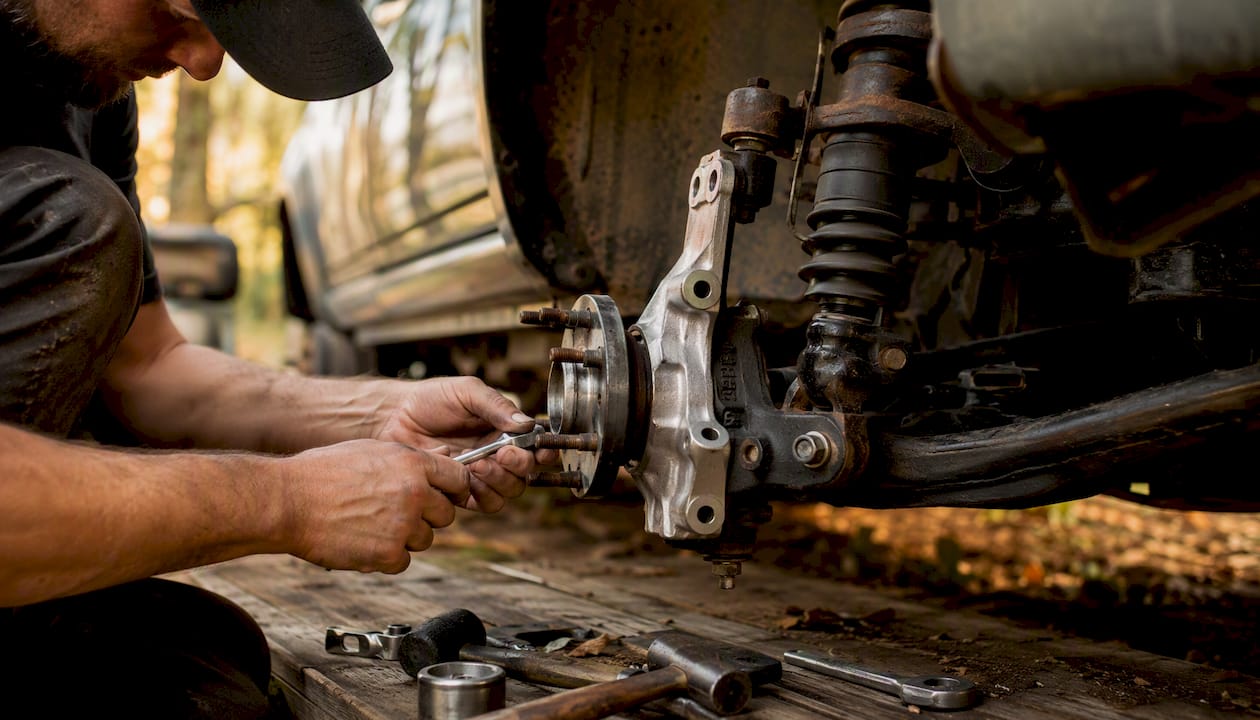
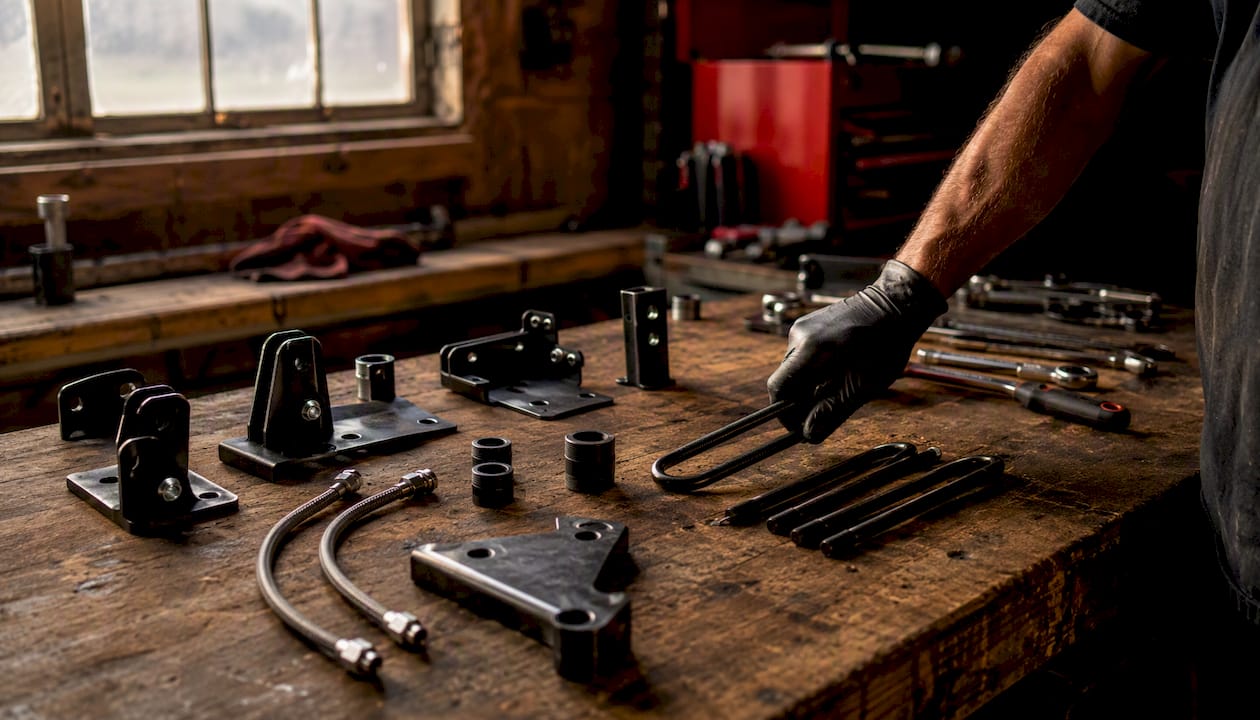
Axle flip kits (rear only) flip the rear axle from above the leaf springs to below them, gaining 4–5 inches of drop at the rear. They require longer U-bolts and often bump-stop modifications. Some vendors sell the flip bracket without the U-bolts, so check the included hardware list carefully.
Coilover systems like the Ridetech Performance Lowering System replace the entire front strut assembly with an adjustable unit. You can dial in ride height and damping independently. These are the right call for owners who want genuine handling improvement alongside the lower stance. Matching spring rates to damping is essential after lowering to preserve handling and prevent undesirable ride behavior.
Air suspension adds a compressor, air bags, and a management system. You can raise and lower the truck on demand, which is useful for show trucks or owners who occasionally tow heavy loads. The downside is cost and complexity. Air suspension offers adjustable height but increases cost and maintenance compared with passive kits.
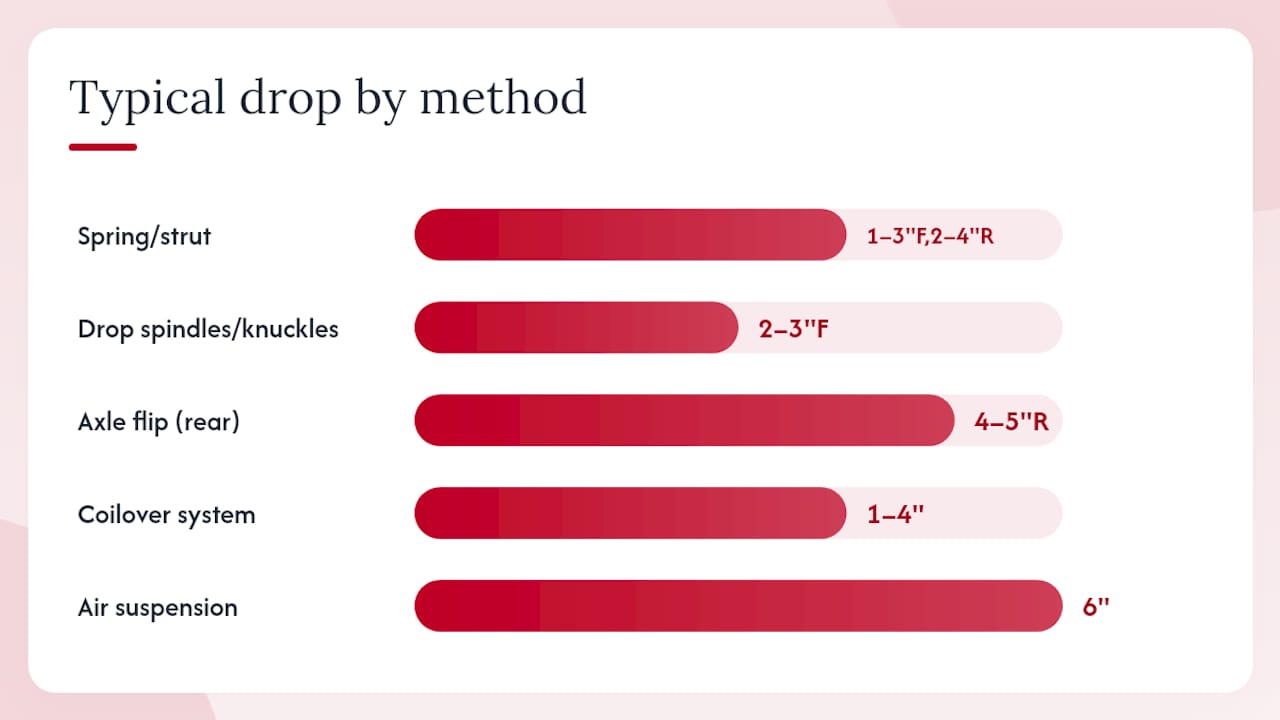
| Method | Typical Drop Range | Ride Quality | Install Complexity |
|---|---|---|---|
| Spring/strut replacement | 1–3" front, 2–4" rear | Firmer than stock | Moderate |
| Drop spindles/knuckles | 2–3" front | Near-stock feel | Moderate–High |
| Axle flip (rear) | 4–5" rear | Depends on spring rate | Moderate |
| Coilover system | 1–4" adjustable | Best with tuning | High |
| Air suspension | 6" adjustable | Excellent when set up well | Very High |
What does a Ram 1500 lowering kit cost?
Budget planning prevents surprises at checkout and at the shop. Parts prices vary significantly by kit type, and labor adds a meaningful amount on top.
| Kit Type | Parts Cost Range | Typical Shop Labor | Alignment Cost |
|---|---|---|---|
| Rear spring swap / leveling | $150–$300 | $100–$150 | $100–$150 |
| 2"/4" complete drop kit | $600–$1,000 | $300–$550 | $100–$150 |
| Drop spindles (front) | — | — | $100–$150 |
| Coilover system | — | $300–$600 | $100–$150 |
| Air suspension system | — | — | $100–$150 |
Basic kits start at a few hundred dollars, while performance and air systems can exceed $2,000 including parts. A complete 2"/4" bolt-on kit with matched shocks typically lands in the $600–$1,000 range for parts alone. Add $300–$550 for professional installation and alignment, and a realistic total for a quality daily-driver drop is $900–$1,550.
Budget note: Never skip the alignment. It costs $100–$150 and protects a set of tires that costs far more to replace early.
What does installation involve, and what must you do after?
A complete 2"/4" drop kit on a 2WD Ram 1500 takes an experienced shop roughly 3–5 hours. DIY installs typically run 6–10 hours for someone with solid mechanical skills and a proper lift or jack stands.
Numbered install checklist:
- Confirm all kit components against the packing list before starting
- Lift the truck and support the frame securely; never work under a truck on floor jacks alone
- Remove factory struts, springs, and rear shocks
- Install front drop spindles or replacement strut/spring assemblies per torque specs
- Flip the rear axle (if applicable) and install new U-bolts to the correct torque
- Install rear lowering springs and matched shocks
- Check brake-line routing and ABS sensor harness clearance at all four corners
- Verify bump-stop contact and shock travel at full compression
- Lower the truck and perform a visual check of all clearances before moving it
- Drive to an alignment shop within the first 100 miles
Alignment is mandatory after any suspension change. Camber and toe shift when ride height changes, and driving on out-of-spec geometry chews through tires fast.
Watch for missing hardware. Axle flip kits frequently omit longer U-bolts and bump-stop spacers. Some kits also exclude extended brake lines, which become necessary when the axle drops far enough to pull the factory line taut.
Pro Tip: Ask the shop to test steering lock-to-lock at full suspension droop before signing off. This catches brake-line tension and CV-angle issues that only show up at the extremes of suspension travel.
How does lowering change ride quality, handling, and wheel fitment?
Dropping the truck changes more than looks. Camber, caster, and toe all shift when ride height drops, and the practical result shows up in tire wear and steering feel within a few thousand miles if the geometry is not corrected.
On a 2"/4" drop, expect a slightly firmer ride and marginally quicker steering response. That is generally a positive trade for most owners. Aggressive drops beyond 3" front can push camber negative enough to cause inner-edge tire wear even after alignment, because the factory control arm geometry was not designed for that range.
Wheel and tire fitment tightens up after lowering. A 275/60R20 that cleared the fender at stock height may rub on the inner liner at full compression after a 2" drop. Common safe combinations on a 2"/4" drop include 275/55R20 or 265/60R20 on a wheel with 4.5"–5" backspacing. Running a wheel with too much positive offset pushes the tire inward and can cause contact with the lower control arm.
Watch for these symptoms after installation:
- Scraping or rubbing at full lock or over bumps (check tire-to-fender and tire-to-control-arm clearance)
- Premature inner-edge tire wear (indicates negative camber; needs alignment correction)
- Steering pull to one side (caster or toe imbalance; alignment issue)
- Harsh bottoming out over dips (bump stops too short or shock travel insufficient)
Damping matters more after a drop than before it. A lowered truck on stock shocks that were designed for a higher spring rate will feel loose and bouncy. Matched shocks or adjustable coilovers keep the spring and damper working together.
How to choose the right lowering kit: a practical checklist
Questions to ask the seller
- What hardware is included? (U-bolts, bump stops, hardware bags)
- Are shocks or struts part of the kit, or sold separately?
- What is the warranty period and return policy if fitment is wrong?
- Are installation instructions or a PDF spec sheet available?
- Does the kit require any auxiliary parts not in the box?
Red flags to avoid
- “Universal fit” kits with no vehicle-specific application data
- Listings with no torque specifications in the instructions
- No mention of post-install alignment requirement
- Missing part numbers or vague drop amounts (“approximately 2–3 inches”)
Vehicle-specific kits with clear model-year and drivetrain labeling reduce fitment issues significantly. A kit that lists exact compatible years, cab types, and drivetrain specs is worth paying more for.
Action plan: Verify fitment → confirm all included components → budget for installation and alignment → order only from a seller with a clear return policy if the kit does not fit.
What warranty and quality standards should you expect?
Quality lowering kits from established brands carry at least a one-year warranty on components, and many performance-grade kits extend that to a limited lifetime warranty on structural parts like spindles and control arms. Shocks and springs typically carry separate, shorter coverage.
What to look for: powder-coated or zinc-plated steel on structural brackets, OEM-spec or better hardware grades, and a warranty that covers defects in materials and workmanship rather than just manufacturing defects. Kits that arrive with no documentation, no torque specs, and no brand markings on the parts are a signal that quality control was not a priority.
How does lowering affect your factory warranty and insurance?
Under the Magnuson-Moss Warranty Act, a dealer cannot void your entire factory warranty simply because you installed an aftermarket suspension kit. They can, however, deny warranty claims on specific components if they can show the modification caused the failure. A blown factory shock after a suspension swap is a gray area; a cracked frame from an unrelated collision is not.
Insurance is a separate matter. Most standard auto policies do not automatically exclude modified vehicles, but some insurers require disclosure of significant suspension modifications. Failing to disclose a modification that affects vehicle height or handling could complicate a claim. Check your policy language and call your agent before the install if you are unsure.
This is general information, not legal or insurance advice. Confirm current rules with your insurer and a qualified professional.
Are there legal limits on how low you can go?
Yes, and they vary by state. Most states regulate minimum ground clearance and require that headlights, taillights, and reflectors remain within specified height ranges after modification. Some states also require that the vehicle pass a safety inspection that includes ride height checks.
A 2"/4" drop on a stock-height Ram 1500 typically keeps the truck well within most state minimums, but aggressive drops of 4"+ front can bring the front fascia close to legal limits in stricter states. Check your state’s DMV or motor vehicle code for the specific minimum clearance requirement before committing to a drop amount.
Maintenance requirements and how long different kit types last
Spring and strut kits from quality brands are low-maintenance. Inspect mounting hardware torque at 6 months post-install and annually after that. Shocks wear on their own schedule regardless of the kit type; plan for replacement every 50,000–80,000 miles depending on road conditions and driving style.
Axle flip kits add U-bolt inspection to the maintenance list. U-bolts can loosen over time, especially in the first few thousand miles after install. Re-torque them at the first oil change after installation.
Air suspension requires the most ongoing attention. The compressor, air lines, fittings, and bags all need periodic inspection for leaks and wear. Moisture in the system is the most common failure point; a quality dryer in the air line extends component life considerably. Budget for bag replacement every 5–10 years depending on use and climate.
Coilover systems sit between the two extremes. The adjusters can seize if left in one position for years; cycling the adjustment a few times annually keeps them free.
Key Takeaways
A model-specific 2"/4" complete drop kit with matched shocks is the most practical Ram 1500 lowering kit for daily drivers, but fitment by model year and drivetrain must be confirmed before ordering.
| Point | Details |
|---|---|
| Match kit to model year | 2009–2018 and 2019+ trucks use different front geometry; never assume cross-compatibility. |
| 4WD needs different components | Dropped spindles or knuckles are required to maintain CV and steering angles on 4WD trucks. |
| Budget for the full job | A quality 2"/4" kit plus installation and alignment typically totals $900–$1,550. |
| Alignment is non-negotiable | Schedule a full alignment within the first 100 miles to protect tires and correct camber/toe. |
| Ozkonickustomz for fitment support | Ozkonickustomz stocks compatible kits and verifies fitment by model year and drivetrain before you order. |
Why fitment verification matters more than brand loyalty
The lowering kit market has a real problem: too many buyers pick a brand name they recognize and order without confirming the exact application. The kit arrives, the part numbers are close but not right, and the return process costs two weeks and a restocking fee. The brand was not the issue. The fitment check was skipped.
The more useful question is not “which brand is best” but “which kit is confirmed for my exact truck.” Belltech’s catalog, for example, covers dozens of Ram 1500 applications, and the difference between a kit for a 2014 Crew Cab 2WD and a 2014 Quad Cab 4WD is not cosmetic. The components are genuinely different. Ridetech’s coilover systems are similarly application-specific, and installing the wrong unit creates geometry problems that no alignment shop can fully correct.
The Belltech 963ND deep-dive on the Ozkonickustomz blog is a good example of what vehicle-specific research actually looks like: part numbers, drop amounts, included hardware, and install notes for a specific application. That level of detail is what separates a confident purchase from a guess.
Ozkonickustomz has the kits and the fitment support to back them up
Ozkonickustomz sources aftermarket suspension components directly from vetted manufacturers, which means the kits in the catalog carry real part numbers, real fitment data, and real warranty coverage. No universal-fit guesswork. If you are shopping for a Ram 1500 drop kit and want to confirm compatibility before you order, the team can cross-reference your VIN, cab type, and drivetrain to point you to the right kit.
The catalog includes air spring solutions like the Ride Control air spring kit for owners who want adjustable ride height, and the Air Lift 1000 air spring kit for load-leveling applications. For tow and haul use cases, the LoadLifter 7500XL handles heavier demands. Fast shipping, a straightforward return policy, and expert support are standard. Head to ozkonickustomz.com to browse compatible kits or reach out with your VIN and get a fitment confirmation before you buy.
Useful sources and spec resources
- [Top 6 Best Lowering Kits for Ram 1500 [2026]](https://vehicleruns.com/best-lowering-kits-ram-1500/)
- Dodge Ram 1500 suspension upgrades: your guide
- How to Drop a Dodge Ram 1500: A Practical Guide
- Lift Kit Ram 1500: 4 in, 6 in & 8 in Buyer’s Guide – Seat Cover Solutions
- How To Beef Up RAM 1500 Suspension
- Unlock Your Ram 1500’s Stance: A Deep Dive into the Belltech 963ND Low – Ozkonic Kustomz LLC
When using any spec sheet or fitment chart, check three things: the exact drop amount (front and rear separately), the list of included hardware, and the compatible model years and drivetrain configurations. If any of those three are missing from the listing, ask before ordering.