

For most daily drivers, a short ram intake delivers the better cost-to-feel ratio. For track builds, hot climates, or forced-induction setups chasing every degree of intake temperature, a cold air intake wins. Budget or engine-bay-limited builds usually land on short ram by default, since a proper CAI needs room to route. The real trade-off comes down to peak power versus throttle response, heat soak, and a small but real hydrolock risk that Ozkonickustomz gets asked about constantly.
TL;DR:
- Cold air intakes are more effective in hot climates and high-RPM applications, providing cooler, denser air that improves engine performance.
- Short ram intakes are easier and faster to install, more budget-friendly, and enhance throttle response at low RPMs.
- Proper fitment and routing are crucial, especially for CAIs, as tight engine bays and obstacles often require fabrication or careful measurement before purchase.
- Both intake types carry hydrolock risks if water enters the filter, so proper sealing, drainage, and height positioning are essential in rainy environments.
- Engine-specific airflow design and maintenance considerations, such as filter cleaning and sensor placement, impact real-world gains more than just intake type.
Table of Contents
- Short Ram vs Cold Air Intake: The Trade-Offs That Matter
- What Dyno Numbers And Temperature Data Actually Show
- What Installing A Short Ram Or Cold Air Kit Actually Involves
- The Real Risks: Water, Heat, And Sensor Fouling
- How To Choose Between Short Ram And Cold Air
- How Ozkonic Kustomz Verifies Fitment Before You Buy
- When We’d Grab A Short Ram First, And When A CAI Earns Its Price
- Get A Fitment-Verified Intake Without The Guesswork
- Sources
Short Ram vs Cold Air Intake: The Trade-Offs That Matter
The two designs solve different problems, and that’s the whole story. A short ram intake (SRI) pulls air from inside the engine bay through a short, wide tube, cutting the restriction of the stock airbox. A cold air intake (CAI) routes that same tube down to a cooler zone, often behind the bumper or fender, then shields it in a sealed box.
That relocation is the entire value proposition of a CAI. Cold air intakes can run 20 to 40 degrees Fahrenheit cooler than the engine bay air an SRI breathes, especially once the car’s been driven hard for ten minutes. Short ram kits skip that complexity entirely, which is exactly why they’re cheaper and faster to bolt on.
Here’s how the two stack up on the factors that actually change a buying decision:
- Power delivery: SRIs tend to sharpen low-RPM throttle response; CAIs tend to add more at mid-to-high RPM, though results vary significantly by vehicle.
- Intake air temperature: SRIs run warmer under sustained load; CAIs stay cooler because the filter sits away from engine heat.
- Cost: open-element short ram kits typically run $40 to $150, while a quality CAI kit runs $150 to $400 or more.
- Install time: SRIs bolt on in under an hour for most people; CAIs often take longer due to fender liner removal and duct routing.
- Sound: SRIs are louder and rasp under throttle since the filter sits close to the engine; CAIs tend to sound deeper and more muted.
- Maintenance: both need regular filter checks, but a CAI’s remote mounting location means more crawling under the car to inspect it.
None of this makes one design objectively better. It makes them suited to different jobs, which is the entire reason the “vs” framing in this debate never really resolves into a single winner.
What Dyno Numbers And Temperature Data Actually Show
Every 10°F drop in intake air temperature adds roughly 1% to engine output, according to a widely cited rule of thumb used across the tuning world. That’s a real number, but it’s also a rule of thumb, not a lab constant. It doesn’t account for humidity, altitude, or how your specific engine’s ECU responds to the cooler charge.
Engineering Explained’s comparative testing found something that surprises a lot of first-time buyers: CAIs generally help more at mid-to-high RPM, while SRIs often win on throttle response and low-RPM feel. On some vehicles, the SRI actually posted higher numbers than the CAI at certain points in the rev range. Vehicle-specific airflow design matters more than the intake label on the box.
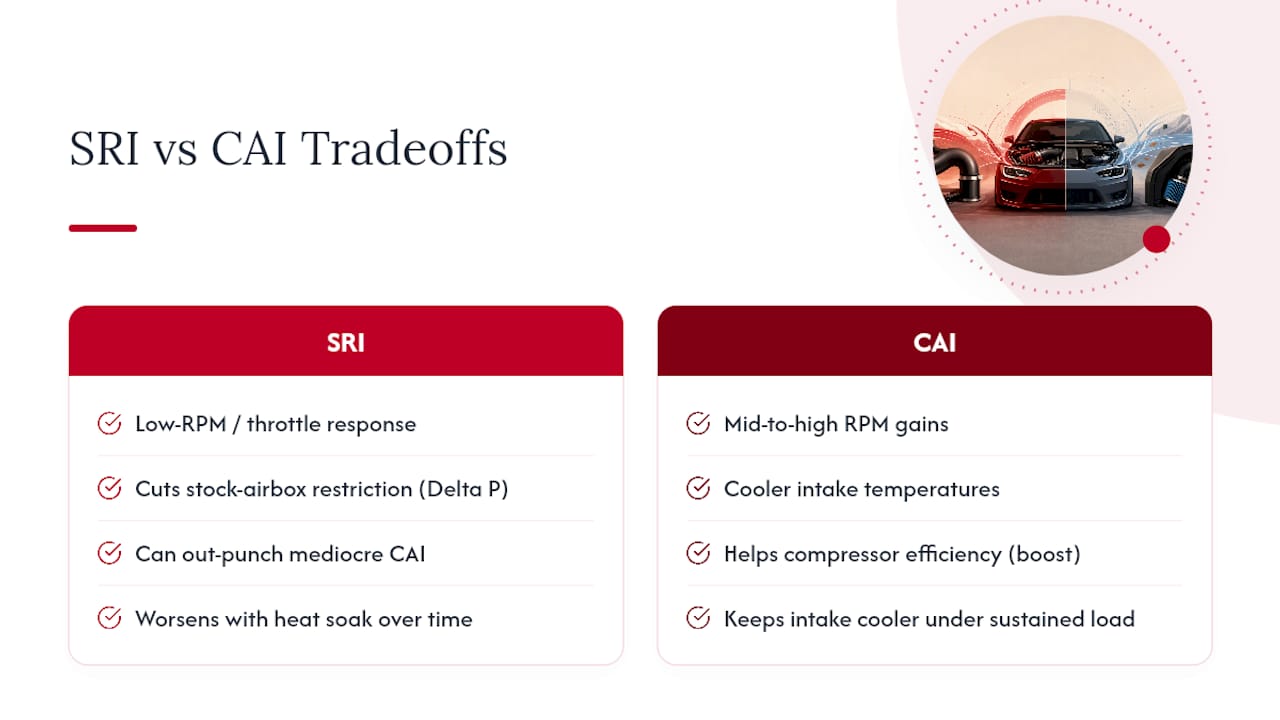
There’s a second factor that gets buried under all the temperature talk: Delta P, or the pressure restriction created by a stock airbox. A well-designed short ram can cut that restriction significantly, delivering an immediate throttle response gain that has nothing to do with air temperature at all. That’s why a cheap SRI can occasionally out-punch a mediocre CAI. Design quality beats the marketing label every time.
Heat soak changes the picture as a drive goes on. At idle or light cruising, an SRI’s intake temperature isn’t dramatically worse than a CAI’s. Push the engine hard for ten or fifteen minutes, sitting in traffic with the hood radiating heat, and that gap widens fast. Realistic expectations: naturally aspirated engines typically see modest, single-digit horsepower gains from either intake. Turbocharged and supercharged engines see more, since cooler, denser air improves compressor efficiency and can compound gains through safely higher boost.
What Installing A Short Ram Or Cold Air Kit Actually Involves
A short ram intake is usually a one-hour job with a ratchet, a few sockets, and maybe a screwdriver for hose clamps. A cold air intake often takes two to three hours, partly because you’re routing a tube through the fender well or behind the bumper, and partly because some vehicles require pulling a fender liner or trimming factory ducting to make room.
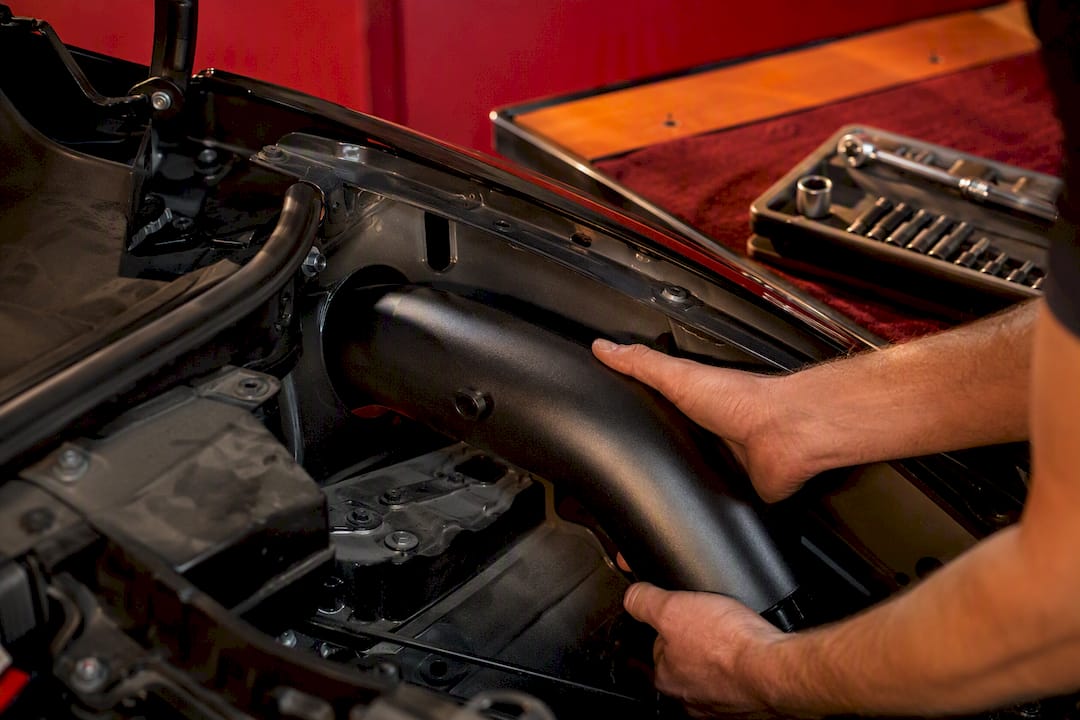
Fitment is where CAIs run into real problems. Turbocharged engines with tight underhood packaging, trucks with skid plates blocking the ideal routing path, and newer platforms with sensor clusters crammed into the fender well can all turn a “bolt-on” CAI into a fabrication project. This is the single biggest reason enthusiasts default to short ram: sometimes a CAI simply won’t fit without cutting, drilling, or relocating something the manufacturer didn’t design to move.
Common installer mistakes show up in both types:
- Loose couplers. A coupler that isn’t fully seated and clamped creates a vacuum leak that tanks fuel trims and throttle response.
- Pinched or kinked hoses. Crown vents and PCV lines routed poorly can choke off vacuum signals the ECU depends on.
- Missight air temperature sensor placement. Mounting the IAT sensor too close to a heat source defeats the point of a cold air setup.
- Skipped torque checks. Intake tubes that vibrate loose over a few weeks usually trace back to under-torqued hose clamps.
Pro Tip: Before you buy a CAI, measure the actual clearance between your fender liner and the frame rail with a tape measure. A lot of “universal fit” kits assume space that simply isn’t there on trucks with aftermarket skid plates or larger tires.
The Real Risks: Water, Heat, And Sensor Fouling
Cold air intakes trade heat protection for a new risk: hydrolock. A low-mounted filter sitting near the front bumper can pull in standing water during a deep puddle or flooded intersection, and water doesn’t compress the way air does. Industry guidance is consistent here: sealed boxes, proper drainage, and mounting the filter higher in the fender well all reduce that risk substantially. This isn’t a reason to avoid CAIs, but it is a reason to check how a specific kit handles water exposure before buying one for a daily driver in a rainy region.
Filter type creates its own trade-off. Oiled filters flow well but have a documented history of over-oiling and fouling MAF sensors, which throws off fuel trims and can trigger a check-engine light. Dry-media filters flow slightly less air but eliminate that failure mode entirely.
A short maintenance checklist covers most of what either intake type needs:
- Inspect the filter every 3,000 to 5,000 miles, more often in dusty or gravel-heavy driving.
- Re-oil oiled filters per the manufacturer’s schedule, never more.
- Check coupler clamps for looseness every oil change.
- Inspect CAI drainage points before the rainy season.
How To Choose Between Short Ram And Cold Air
Start with three questions: where do you actually drive, is your engine turbocharged or naturally aspirated, and how much fabrication are you willing to do?
Daily drivers in dry climates with moderate budgets usually get the most value from a short ram. The install is fast, the sound is satisfying, and the throttle response improvement is noticeable within the first mile. Commuters in genuinely hot climates, or anyone chasing every available horsepower on a turbocharged platform, benefit more from a CAI’s cooler, denser charge air. Track and drag builds tend to favor CAI as well, since sustained high-RPM runs are exactly where the temperature advantage compounds. Cramped engine-swap builds are the wildcard: sometimes there’s no room for a CAI at all, and a well-shielded short ram with a properly shaped velocity tube becomes the smarter, more realistic choice.
A practical decision path looks like this:
- Measure your engine bay and check whether a CAI’s routing path is physically open, especially around turbo inlets and skid plates.
- Decide your climate tolerance. Frequent deep-puddle driving or flash flooding in your area should push you toward a sealed, higher-mounted design or away from CAI altogether.
- Set a budget that includes the filter type and any coupler or hardware upgrades, not just the base kit price.
- Check fitment-verified product listings before ordering rather than relying on generic “universal fit” claims.
Many enthusiasts start with a short ram to learn the install and get a feel for the gains firsthand, then upgrade to a CAI later once the vehicle’s build justifies the added cost and complexity. That staged approach avoids buying more intake than a build actually needs.
How Ozkonic Kustomz Verifies Fitment Before You Buy
Every intake kit Ozkonic Kustomz lists gets checked against actual vehicle specs before it goes live, not just the manufacturer’s generic fitment chart. That vetting process is why enthusiasts come back: it eliminates the guesswork of ordering a “universal” kit that turns out to need custom fabrication.
- Vendors are vetted directly, cutting out counterfeit parts and mismatched fitment data.
- Product pages list confirmed compatibility rather than broad, unverified fit ranges.
- Buyer guides walk through routing, clearance, and filter-type decisions before you commit to a purchase.
- Support is available for fitment questions before and after the order ships, backed by a straightforward return policy if something doesn’t match your engine bay.
That process matters more for intakes than almost any other part category, since a half-inch of missing clearance is the difference between a clean install and a return shipment.
When We’d Grab A Short Ram First, And When A CAI Earns Its Price
For a commuter or a first modification, we’d reach for a short ram every time. It’s cheap, it’s fast to install, and the throttle response gain is real enough to notice on the first drive. Track builds and turbocharged platforms are a different conversation. Once you’re chasing sustained power at high RPM or trying to squeeze extra boost safely, the cooler, denser air a CAI delivers starts pulling its weight.
The honest trade-off: CAIs cost more, take longer to install, and carry a hydrolock risk that SRIs simply don’t have. In wet climates, we’d lean conservative and prioritize sealed, higher-mounted designs, or stick with a short ram until fitment and drainage details check out.
— Ozkonic Kustomz
Get A Fitment-Verified Intake Without The Guesswork
Ozkonickustomz built its intake catalog around one problem enthusiasts keep running into elsewhere: kits that claim universal fitment but don’t actually clear the fender liner or turbo inlet on their specific truck. Every listing here gets checked against real vehicle specs before it’s published, so what you order is what actually bolts up.

If you’re weighing a short ram against a full cold air setup, start by reading the performance breakdown on cold air versus short ram intakes to match the design to your engine bay, then browse fitment-confirmed hardware like the modular wiring kit built for truck mounts to round out the install. Got a question about clearance or routing before you buy? Reach out to Ozkonickustomz support and get a straight answer instead of a guess.
Sources
For deeper technical detail, OnAllCylinders’ breakdown of intake design differences and Engineering Explained’s dyno comparison cover the mechanics in more depth. For filter maintenance schedules, this air filter service guide is a solid reference. Internally, the performance parts guide for daily drivers covers how intake choice fits into a broader build plan.
- What’s the difference between a cold air intake & a short ram intake? — OnAllCylinders
- Engineering Explained: Cold Air Intakes Vs Short Ram Intakes | CarThrottle
- Short Ram Intake vs Cold Air Intake: Which Is Better? — Car Care Total